ပင်းတယရွှေဥမင်
Pindaya Golden Cave
Useful Information
| Location: |
In the hill above Pindaya village.
(20.9255114, 96.6505039) |
| Open: |
All year daily 6-18, [2020] |
| Fee: |
Adults MMK 3,000. Foto and Video Permit MMK 300. [2020] |
| Classification: |
 Karst Cave Karst Cave
 Cave Church Cave Church
|
| Light: |
 Electric Light Electric Light
|
| Dimension: | L=150 m. |
| Guided tours: | self guided |
| Photography: | allowed with permit |
| Accessibility: | no |
| Bibliography: | |
| Address: | |
| As far as we know this information was accurate when it was published (see years in brackets), but may have changed since then. Please check rates and details directly with the companies in question if you need more recent info. |
|
History
| 1750 | beginning of use as a temple. |
| 1773 | date on oldest known buddha statue. |
| 1842 | huge bell in the cave cast. |
Description
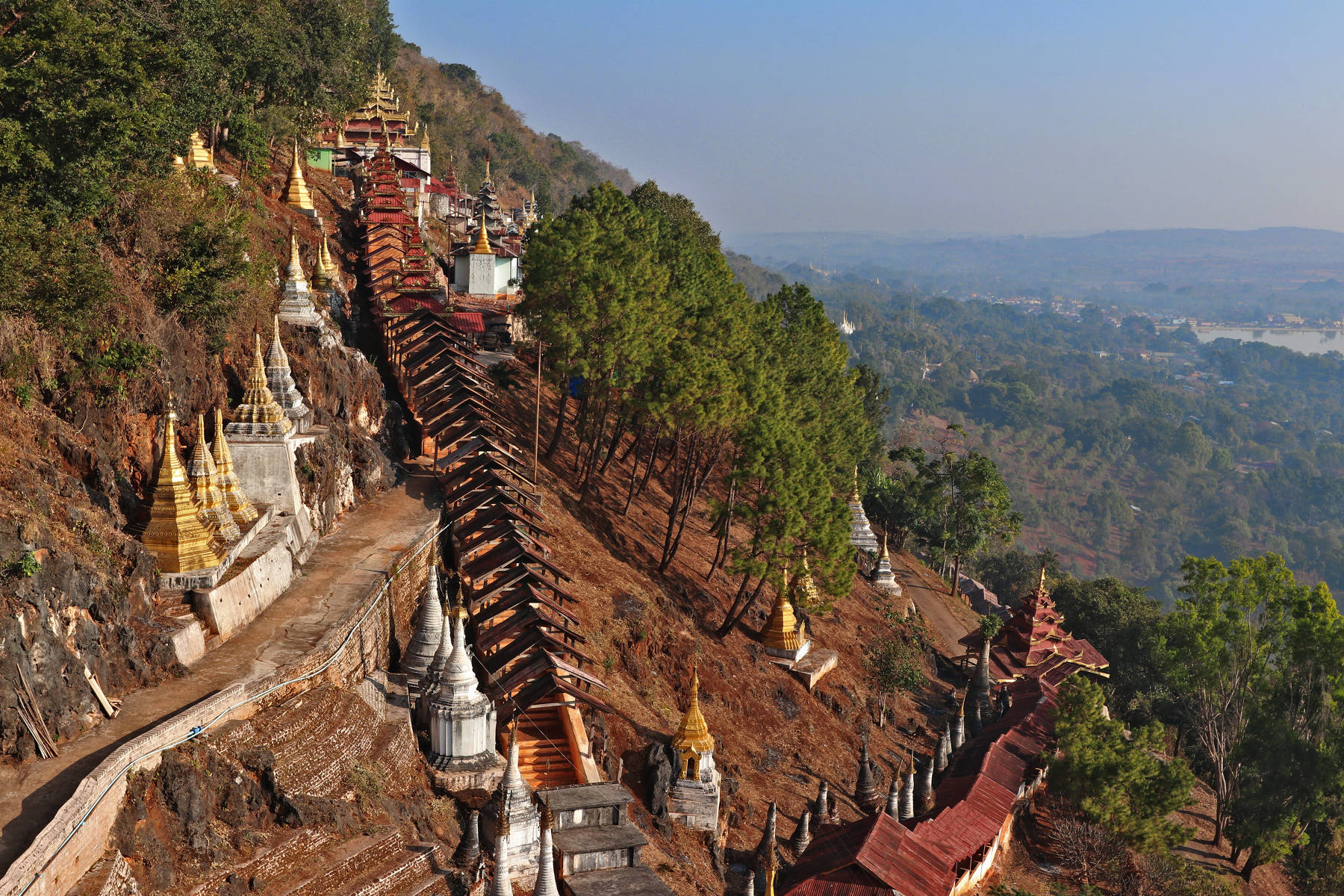
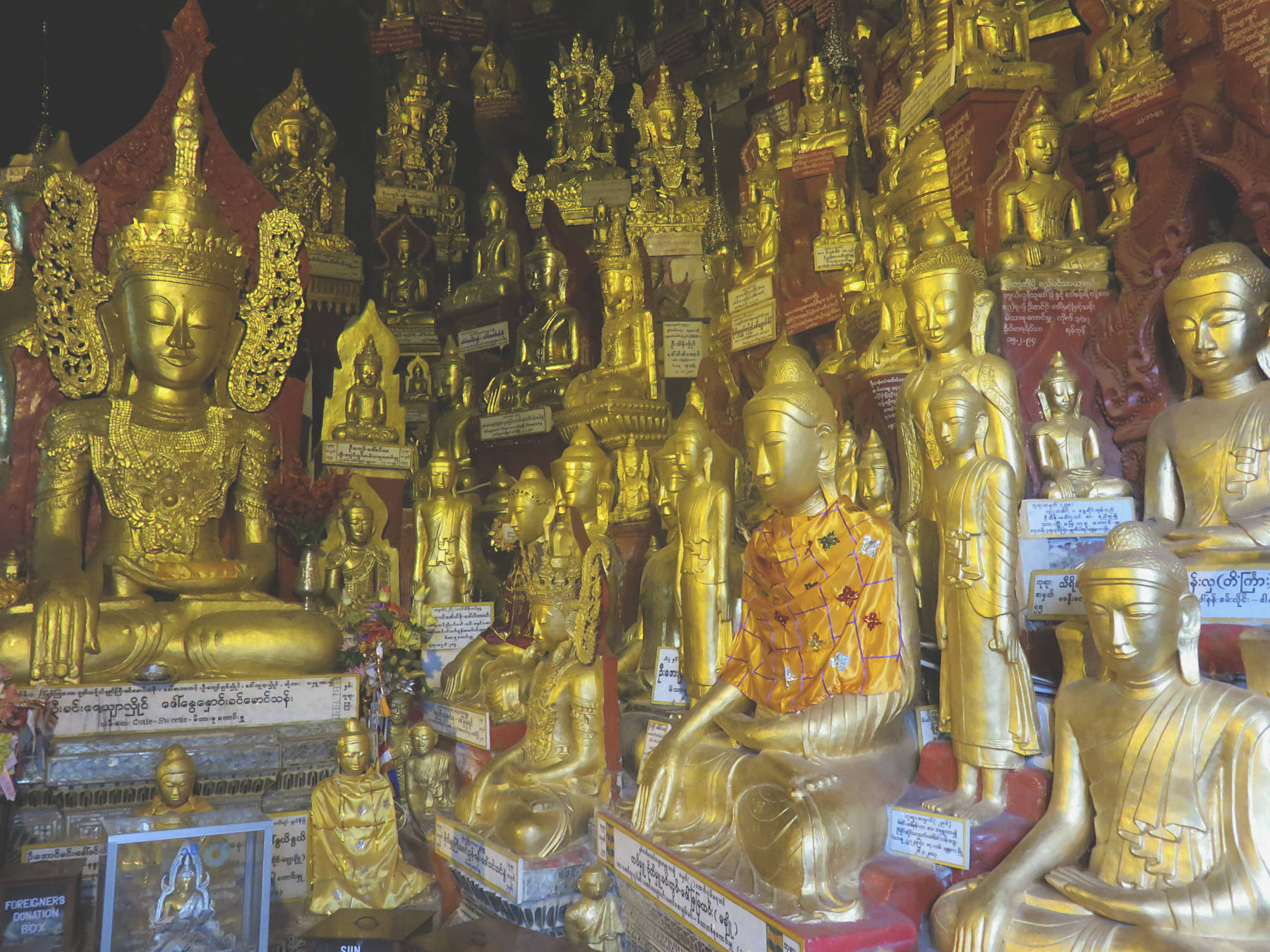
ပင်းတယရွှေဥမင် (Pindaya Golden Cave) is a natural karst cave of some size, passages up to 10 m high, with many speleothems. But it is famous for the artificial content, virtually thousands of golden Buddha statues in all shapes and sizes, hence the name Golden Cave. The cave is used as a holy place and buddhist temple, so it is actually heavily damaged by the use and most speleothems are destroyed. The side passages are numerous and used for meditation and praying.
The Buddha statues cover most of the main chamber and almost every corner of the cave. The origin of the statues is not known, it seems clear that they were created over a very long time, by different artists using completely different materials and techniques. Some are made of teak wood, the main export article of Myanmar, others are made of alabaster, brick, marble, plaster, or even cement. Some are covered by lacquer but most are covered by gold. Today statues are newly installed by Buddhist organizations from as far as Singapore, Netherlands, and the USA. The current amount of statues is somewhere between 8,000 and 9,000, and there are different exact numbers given, it seems to be rather difficult to count them. The number we read most often is 8,094, so we guess there is a chance that this might be the true number.
The huge monastery around the cave is named Shwe Oo Min Pagoda (Golden Pagoda). There are virtually thousands of golden stupas, starting at a huge field where they are aligned in rows, along the trail to the cave, and after the cave the trail goes further up the hill with even more. The main buildings of the monastery are above the cave at the flank of the hill. The trail forms a loop along the cave and monastery and is covered by thousands of small roofs, which provide protection from the hot sun or from heavy rains during monsoon.
There are actually numerous names used for this site, and due to the difficulties with the translation, the names are often mixed up. Even the english Wikipedia page has such difficulties. So we try to explain the basic names and their meaning. First of all, ပင်းတယ (painntay, Pindaya) is the name of the nearby village, and it makes this place name unique, as Golden Cave and Golden Temple are both quite common in Myanmar. Actually Myanmar is often called the "Land of the Golden Pagoda" (or the "Golden Land") because thousands of its Buddhist stupas and temples are covered in real gold leaf and plates. The official full name of this place is ပင်းတယရွှေဥမင်သဘာဝလိုဏ်ဂူဘုရား (painntay shwayumain sabharw longuu bhurarr, Pindaya Golden Cave Natural Cave Temple), which obviously means the "cave temple in the Golden Cave". ပင်းတယရွှေဥမင် (painntay shwayumain, Pindaya Golden Cave) is shorter and the name of the cave, not mentioning the temple. Nevertheless, the temple it is present in this name, as "Golden" is a reference to the golden Buddhas, which refers to the temple. But there is another aspect which is not cave related, the ကံကော်တစ်ထောင်ဘုရား (kankaw taithtaung bhurarr, Thousand Lucky Buddhas), which actually means the surroundings of the cave. There is a number of stupas and Buiddha statues in the plain below as well as along the staircase leading up to the cave entrance. And finally there is another term, which is used for the Wikipedia page, which is the plural Pindaya Caves. The reaso for this is the fact that there are three caves in the hill, only the first is used as cave temple. The other two, which a more or less ignored by the visitors, are further up the trail and as far as we know also wotht a visit. Unfurtunately, we actually have no info about their state, but as we understand those are easy to visit horizontal caves and there is no gate, so access is not restricted.
And finally there are numerous legends surrounding the cave temple. One is the classic far connection legend, which states that a blocked-off path at the end of the cave leads to the ancient city of Bagan. Then there is a legend about seven princesses bathing in the lake which were captured by a giant spider and trapped in the cave. Prince Kummabhaya of Yawnghwe rescues them. There is a huge sculpture of a spider and the prince aiming with his bow and arrow at the covered staircase.
 Search DuckDuckGo for "Pindaya Golden Cave"
 Google Earth Placemark
 OpenStreetMap
 Pindaya Caves - Wikipedia (visited: 04-AUG-2020)
 Myanmar Burma Pindaya Photo Gallery - 11 Pindaya cave picture
 Index
Index Topics
 Hierarchical
 Countries
 Maps
Maps