Ακροπολη Αρχαιας Τιρυνθας
Acropolis of Ancient Tiryns
Useful Information
| Location: |
Τ.Κ. 21 100, Tiryntha, Tiryns.
North of Nafplio, south of Argos, Argolis, Peloponnese. (37.600436, 22.798748) |
| Open: |
All year daily 8:30-15:30. Good Friday 12-17, Holy Saturday 8:30-15:30. Closed 01-JAN, 25-MAR, 01-MAY, Easter Sunday, 25-DEC, 26-DEC. [2026] |
| Fee: |
Adults EUR 10, Reduced EUR 5. JUN to SEP Reduced Ticket not available. Free admission days: 06-MAR, 18-APR, 18-MAY, European Heritage Days, NOV to MAR 1st 3rd Sun. [2026] |
| Classification: |
 Casemate Casemate
|
| Light: | bring torch |
| Dimension: | |
| Guided tours: | self guided |
| Photography: | allowed |
| Accessibility: | no |
| Bibliography: |
Eberhard Zangger (1994):
Landscape changes around Tiryns during the Bronze Age
American Journal of Archaeology 98.2 (1994): 189-212
researchgate
DOI
Heinrich Schliemann (1885) Tiryns: The prehistoric palace of the kings of Tiryns, the results of the latest excavations Charles Scribner’s Sons, London, 1885 pdf |
| Address: |
Tiryns, Τ.Κ. 21 100, Tiryntha, Tiryns, Tel: +30-27520-22657.
E-mail: |
| As far as we know this information was accurate when it was published (see years in brackets), but may have changed since then. Please check rates and details directly with the companies in question if you need more recent info. |
|
History
| 1876 | first excavations by Heinrich Schliemann. |
| 1884/5 | Heinrich Schliemann and his assistant W. Doepfeld excavate part of the Upper Citadel. |
| 1905 to 1920 | excavations by the German Archaeological Institute on the Acropolis and in the surrounding area. |
| 1950s | excavations by the Ephore of Antiquities, N. Verdelis. |
| 1967 | excavations by the German Archaeological Institute directed by Ulf Jantzen and Klaus Kilian reveal large parts of Tiryns. |
| 1999 | inscribed on the UNESCO World Heritage List. |
Description
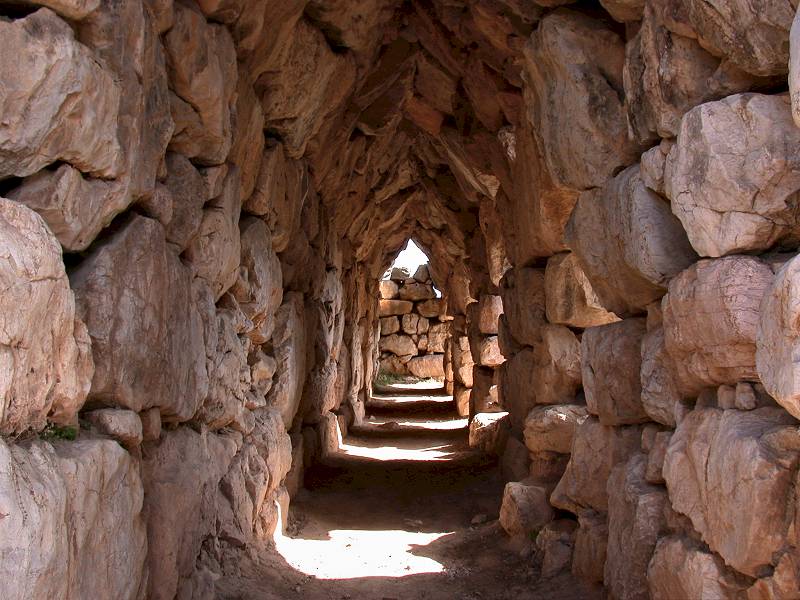
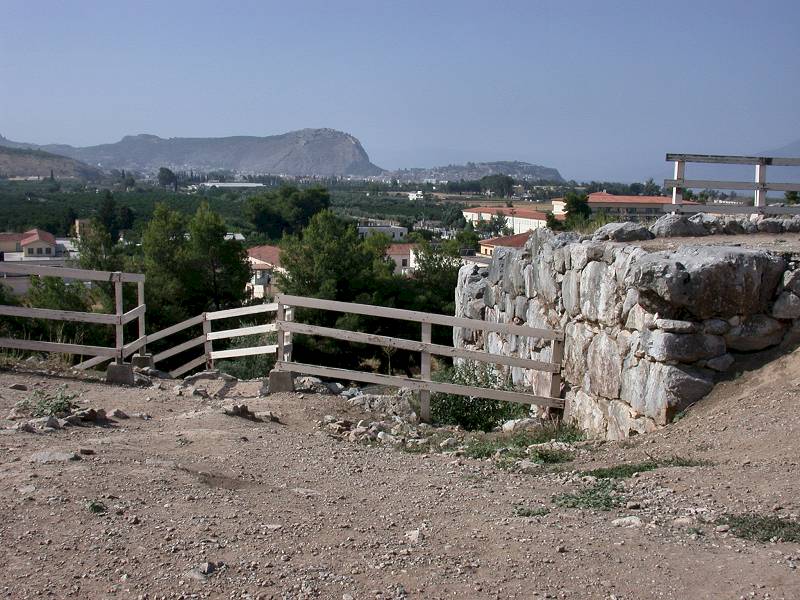
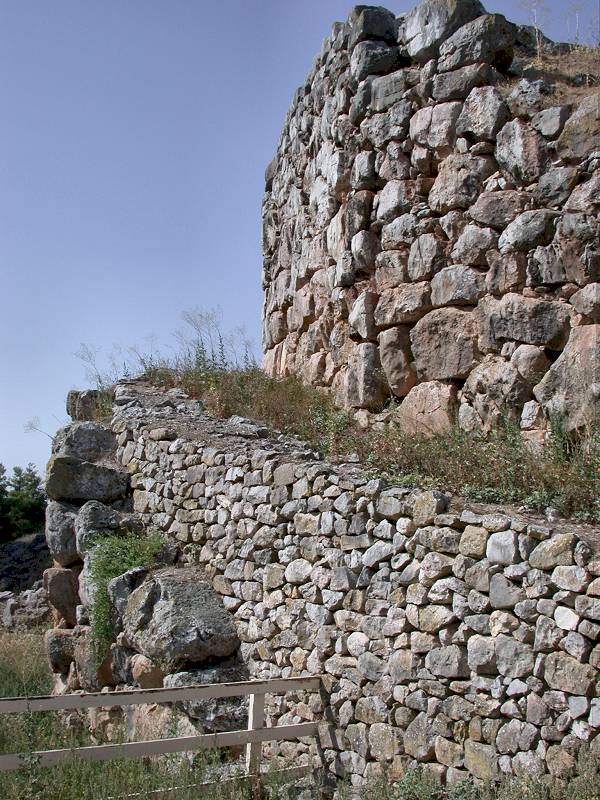
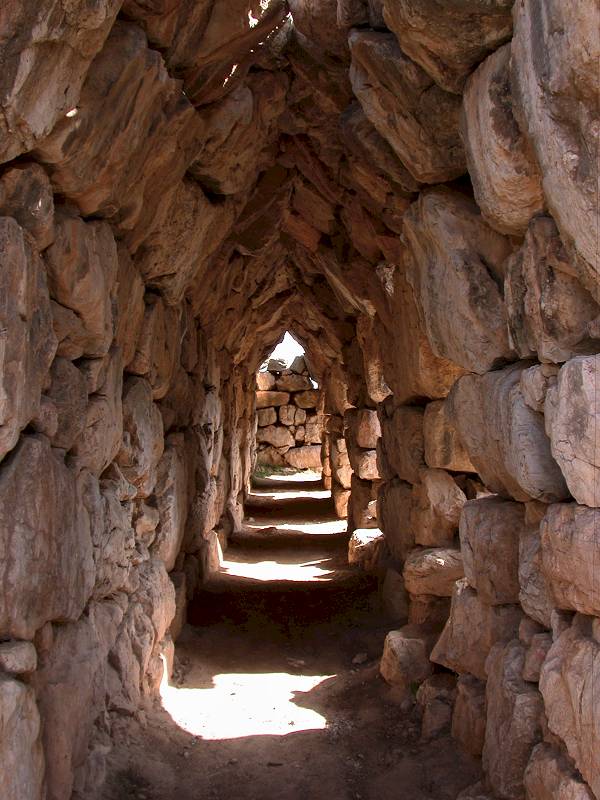
Τίρυνς or Τίρυνθα (Tiryns) is a Mycenaean archaeological site on the Peloponnese, located 20 km south of Mycenae. The full name is thus Μυκηναϊκή Ακρόπολη Τίρυνθας (Mycenean Acropolis of Tiryns). According to ancient Greek legends, the mythical hero Heracles started his Twelve Labours here. Tiryns was a hill fort which was occupied since 7,000 BP, in other words it was inhabited before the beginning of the Bronze Age, during the Neolithic. But its heydays were between 1400 and 1200 BC, at this time it was one of the most important centers of the Mycenaean world. It had a population of 10,000 people and covered 20–25 hectares, this fortified hill was the center, the citadel or acropolis. The hill had a massive wall which was constructed of huge blocks, which is why Homer called the city "mighty walled Tiryns". But the reason why we list this site on showcaves.com is obviously underground: the fortress has Cyclopean tunnels.
The most spectacular part of the ruins are the walls, because the lower part of the walls survived all around the hill. Up to 7 m of the wall can be seen, the original height was probably 9–10 m. They are normally 6 meters thick, but at some points they are up to 17 m thick. These are the places where tunnels pass through the wall. Those masonry tunnels served as a refuge for the inhabitants of the lower city in times of danger.
The excavations of this site started with the German businessman and hobby archaeologist Heinrich Schliemann. His first excavation here was in 1876, in 1884/1885 he excavated part of the Upper Citadel with his assistant W. Doepfeld. Over the decades there were numerous excavations by the German Archaeological Institute and the Ephore of Antiquities revealed more parts. The current state is a result of extensive excavations directed by Ulf Jantzen and Klaus Kilian from 1967. They revealed the whole of the Upper and the Lower Citadel, part of the mycenaean town and part of the Iron Age Cemetery. The excavated artifacts are on display in the National Archaeological Museum and the Archaeological Museum of Nauplio.
- See also
 Subterranean World Heritage List
 Search DuckDuckGo for "Acropolis of Ancient Tiryns"
 Google Earth Placemark
 OpenStreetMap
 Tiryns - Wikipedia (visited: 22-FEB-2026)
 Tiryns, Τ.Κ. 21 100, Tiryntha, Tiryns (Prefecture of Argolida) (visited: 22-FEB-2026)
- Archaeological Sites of Mycenae and Tiryns - UNESCO World Heritage List (visited: 22-FEB-2026)
 Index
Index Topics
 Hierarchical
 Countries
 Maps
Maps