Bergbau-Museum Bad Bleiberg


Useful Information
| Location: |
Thermenweg 8, 9530 Bad Bleiberg
(46.628234, 13.675036) |
| Open: |
MAY to OCT daily 10-18. NOV to APR daily 10-16. [2025] |
| Fee: |
free. [2025] |
| Classification: |
 Lead Mine
Zinc Mine Lead Mine
Zinc Mine
|
| Light: |
 Electric Light Electric Light
|
| Dimension: | |
| Guided tours: | self guided |
| Photography: | allowed |
| Accessibility: | no |
| Bibliography: |
Wolfram Enzfelder (1972):
Geschichte des Blei-Zinerzbergbaues Bleiberg,
Veröffentlichungen aus dem (des) Naturhistorischen Museum(s), NF_006: 3-6.
pdf

|
| Address: |
Tourismusinformation Bad Bleiberg, Thermenweg 1, 9530 Bad Bleiberg, Tel: +43-4244-31306.
E-mail: Bergmännischer Kulturverein Bad-Bleiberg, Kirchweg 1, 9530 Bad Bleiberg. E-mail: Obmann: Jakob Wirnsperger, Tel: +43-4244-2608. |
| As far as we know this information was accurate when it was published (see years in brackets), but may have changed since then. Please check rates and details directly with the companies in question if you need more recent info. |
|
History
| 800 BC | Lead figures found in the Frög burial ground (Rosegg) provide evidence of lead mining during the Bronze Age. |
| 200 BC–50 | Tubes, clamps and weights made of Carinthian lead on the Magdalensberg mountain excavated. |
| 24-JUN-1333 | First documented mention of Bleiberg as a lead ore mining area. |
| 1480 | First boom in mining in Bleiberg. |
| 1487–1495 | Oldest mining regulations for Bleiberg issued. |
| 1768-1808 | Mines become state property. |
| 1857 | with the Industrial Revolution, strong competition arises from Germany, Poland and England. |
| 1867 | Bleiberger Bergwerks Union (Bleiburg Mining Union) founded. |
| 1894 | Franz-Joseph-Erbstollen (Franz Joseph adit) opened. |
| 1951 | Thermal water ingress in the Rudolf mine. |
| 01-OCT-1993 | End of mining in Bad Bleiberg. |
| 24-JUN-2023 | Mining museum opened. |
Geology
The Erzberg in Bad Bleiberg on the sunny side of the Bleiberger Hochtal valley stretches 10 km from Bleiberg-Kreuth and Kobesnock in the west to Kadutschen and Spitzeck in the east. It is part of the Gailtal Alps, which consist of a section of the Eastern Alpine limestone cover systems, a remnant that was not pushed northwards to form the Northern Limestone Alps. The deposit consists mainly of zinc blende and galena, a sedimentary Pb-Zn mineralisation in Triassic Wetterstein limestone.
Description


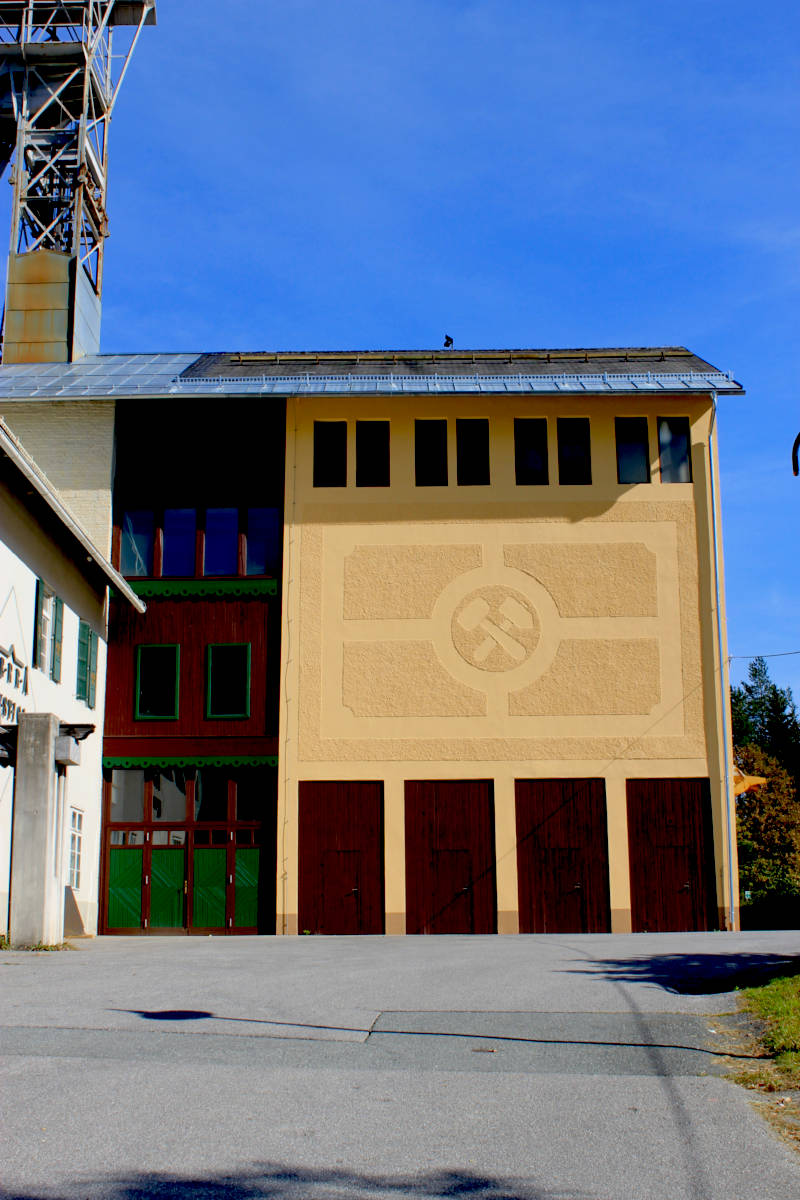
The Bergbau-Museum Bad Bleiberg is in a way the successor to the Bergbaumuseum Klagenfurt. The collection was not to rot away in a cellar, and after it was decided not to reopen the museum in Klagenfurt, the exhibits went on permanent loan to the Carinthian State Museum. Some exhibits are on display in the new mining museum in Bad Bleiberg, while the rest are stored in the mining history archive at the museum. The new museum uses a historic building, the winding shaft of the Rudolfsstollen mine. The construction of the museum only cost 250,000 euros, about half the annual budget of Klagenfurt. This is probably due to the fact that the renovation of the building and the design of the interior was carried out by volunteers from the Bergmännischer Kulturverein. Automation with motion detectors has saved on personnel. In addition, there are significantly more visitors in the popular and well-visited spa town.
The central theme of the museum is the history of mining in Bad Bleiberg, i.e. lead. Highlights include globally unique lead cult chariots and replicas of the famous lead figurines from the Hallstatt burial mounds of Frög near Rosegg. Other lead artefacts include lead pipes and lead types for book printing. 2500 kg of lead ingots are an impressive end product of mining.
Lead was already being mined in the Bronze Age, as evidenced by lead figures found in the Frög burial ground (Rosegg). Carinthian lead is also known from the Celtic and Roman periods, for example in the form of tubes, clamps and weights found on the Magdalensberg. In the first documented mention from 24-JUN-13333, Bishop Werntho von Bamberg granted Heinrich Putigler a castle fiefdom on the "Pleyberg pey Villach". The oldest mining regulations for Bleiberg were issued between 1487 and 1495. They regulated the mining of ores, their extraction and sorting, as well as the miners' wages and working hours. At the height of mining activity, 500 to 600 miners worked in Bleiberg.
The mineral collection focuses on Carinthia. Minerals whose type locale, i.e. the first place where they were found, is in Carinthia are a major theme. These include: Hydrozinkite, Ilsemannite and Wulfenite (lead and zinc mining Bleiberg-Kreuth), Kahlerite and Löllingite (iron mining Hüttenberg), Weinebeneit (spodumene test gallery, Brandrücken, Koralpe), and Zoisite (Kupplerbrunn, Saualpe). The most unusual object is a single smoky quartz crystal weighing 200 kg, which comes from the Schwarzkopf in the Ankogel group. The minerals and lead ores of Bad Bleiberg and its accompanying minerals are an important topic. The history of the thermal water, which comes from the former mining operations, is also explained.
 Search DuckDuckGo for "Bergbau-Museum Bad Bleiberg"
 Google Earth Placemark
 OpenStreetMap
 Bleiberger Erzberg
  Mining Museum Bad Bleiberg, official website (visited: 06-AUG-2025)
 Index
Index Topics
 Hierarchical
 Countries
 Maps
Maps