Niedaltdorfer Tropfsteinhöhle
Tufa Cave of Niedaltdorf
Useful Information
| Location: | A8 exit Rehlingen, through Siersburg towards French border, 5 km to Niedaltdorf. In Rehlingen-Niedaltdorf at the turnoff of the Gerstlinger Straße. In the cellar of the house at Neunkircher Str. 10. |
| Open: |
Closed. [2019] |
| Fee: |
Closed. [2019] |
| Classification: |
 tufa cave
primary cave tufa cave
primary cave
|
| Light: |
 Incandescent Electric Light System Incandescent Electric Light System
|
| Dimension: | L=120 m, A=185 m. |
| Guided tours: | L=80m |
| Photography: | allowed |
| Accessibility: | access with elevator to first part of the cave, the rest is level but narrow and partly low |
| Bibliography: |
R. Loeser (1934):
Die Niedaltdorfer Tropfsteinhöhle,
Rhein. Heimatpfl. Jg. 6, 1934
( ) )
H. Rücklin (1940): Die Tropfsteinhöhle von Niedaltdorf, Westm. Abh, z. Landes- und Volksforschung, Bd. 4, 1940 ( )
K. Britz (1952): Wie ist die Niedaltdorfer Tropfsteinhöhle?, Saarl. Volksztg. Nr. 4, 7.1.1952 ( )
E. Müller (1963): Die Tropfsteinhöhle in Niedaltdorf, Heimatk. Jahrbuch d. Kr. Saarlouis, 1961-1963 ( )
Dr. Gerhard Müller (2014): B-PSL INVENTAR 6605.01 Niedaltdorf, "Tropfsteinhöhle",  online
() online
()
|
| Address: | Tropfsteinhöhle Niedaltdorf, Neunkircher Str. 10, 66780 Rehlingen-Siersburg (OT Niedaltdorf). |
| As far as we know this information was accurate when it was published (see years in brackets), but may have changed since then. Please check rates and details directly with the companies in question if you need more recent info. |
|
History
| 1880 | first parts discovered, when the Restaurant "Zur Tropfsteinhöhle" was built. |
| 1927 | discovered again during renovation works in the cellar. |
| 1928 | Willi Biehl builds a staircase and an adit and discovers the longer east branch. |
| 1933 | development, round trip completed and electric light installed. |
| 1937 | protected by law as a natural monument. |
| 2014 | Cave closed. |
| 2018 | Cave sold to the Naturlandstiftung Saar. |
| 2020 | after renovation again open to the public. |
Description
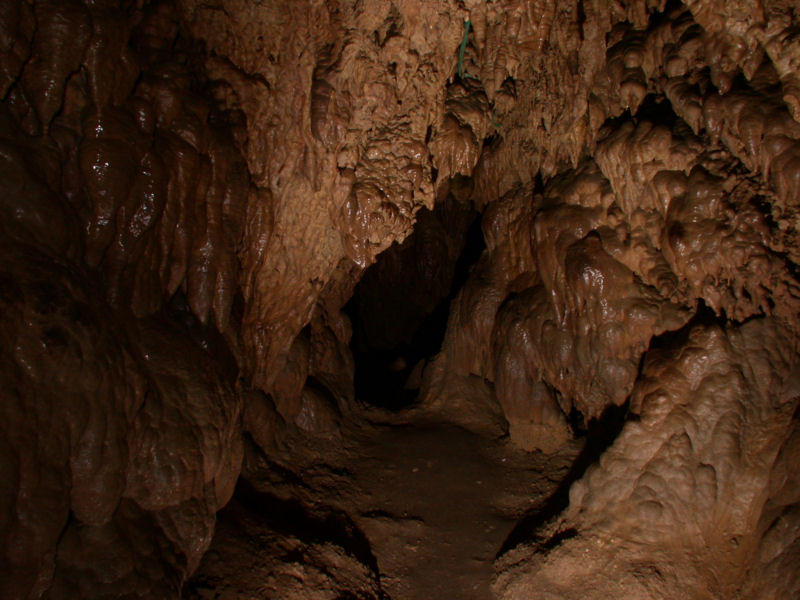
The Niedaltdorfer Tropfsteinhöhle is a
tufa cave, and belongs to the rather rare
 primary caves.
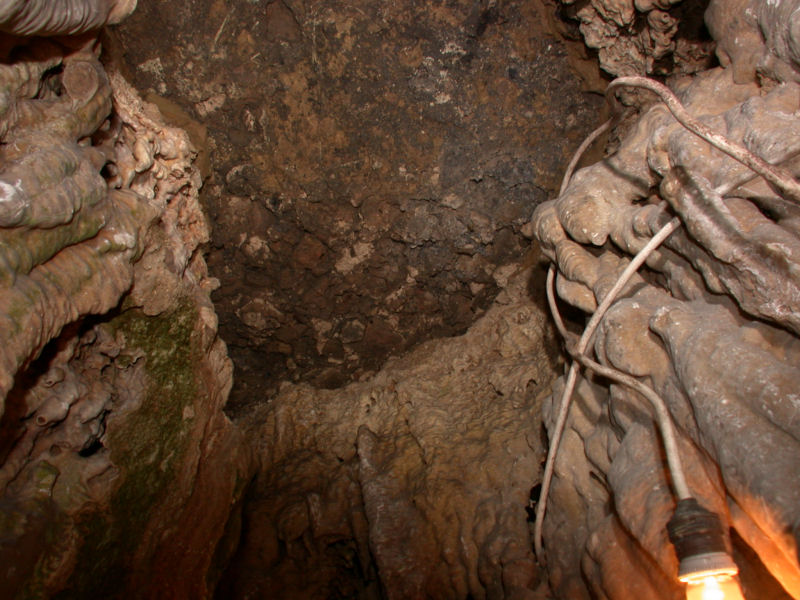
It is located inside a 200 m long, 40 m wide and 8 m high deposit of tufa, also known as sweetwater limestone.
This deposit was formed during the last 10,000 years at the spring of a limestone rich brook, a tributary of the Nied.
The Tufa Cave of Niedaltdorf was formed when the tufa was deposited, because of irregular growth of the limestone.
Waterfalls, pools, overhanging rims and later shallow caverns were formed.
About 8,000 years ago some of those overhangs were closed by growing limestone and so the cave was formed.
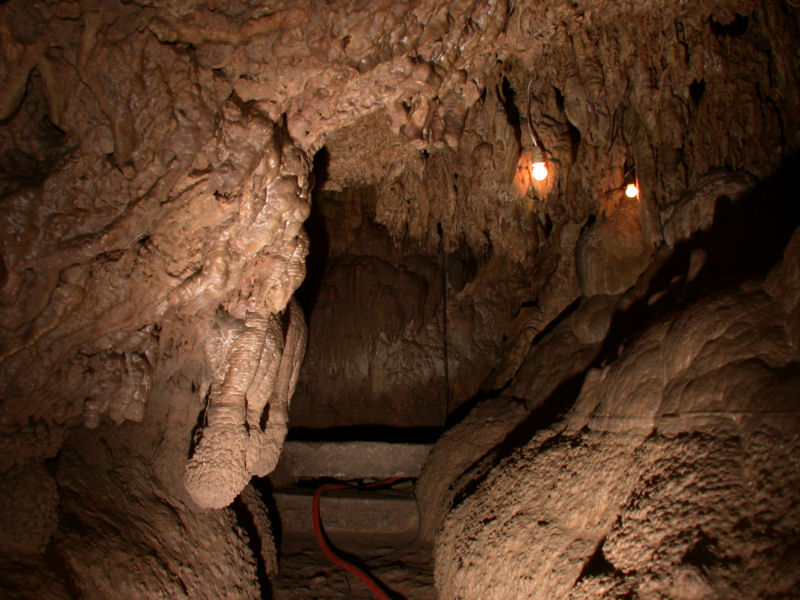
The cave consists of two passages, the 15 m long west passage and the 42 m long east passage.
primary caves.
It is located inside a 200 m long, 40 m wide and 8 m high deposit of tufa, also known as sweetwater limestone.
This deposit was formed during the last 10,000 years at the spring of a limestone rich brook, a tributary of the Nied.
The Tufa Cave of Niedaltdorf was formed when the tufa was deposited, because of irregular growth of the limestone.
Waterfalls, pools, overhanging rims and later shallow caverns were formed.
About 8,000 years ago some of those overhangs were closed by growing limestone and so the cave was formed.
The cave consists of two passages, the 15 m long west passage and the 42 m long east passage.
The owner of the cave had his own theory about how the cave was formed. He assumed that the Nied flooded the tufa during floods and that the water dug deep channels into the tuff. Alternatively, the Ihner Bach is also suggested as the cause for the formation of gullies. This gullies were then again overgrown by tuff. This theory is extraordinary, but no traces of erosion are visible in the cave. So this theory, although widely published in guidebooks and newspapers, is most likely wrong.
Further exotic theories can be found in the article Höhlen des Saargebiets (Caves of the Saar area) by Prof. Dr. Rudolf Loeser. He first suspects a fault zone, the Sprung von Gorze, as tectonic cause for the fissures, but then has to admit that the fault zone is older than the calcareous tufa. He does not want to completely abandon the tectonic cause and continues to suspect that underlying gypsum layers in the Muschelkalk were dissolved by the water of the Nied and thus caused sliding movements in the rock. Particularly helpful was the increasingly stronger solution closer to the Nied, which formed a ramp on which the lower part of the tufa slid down towards the Nied, thus opening up a crevice. Again a quite imaginable theory, but such tectonic caves have some geometrical peculiarities, which cannot be found here. First, after breaking apart, the two sides of the crack, like positive and negative, must fit into each other. This is not the case here. Second, such a fissure is always exactly the same width or its width increases in one direction constantly. Anyone who has ever cut off a piece of cake knows what I mean. This is also not the case here, the cave corridor varies in its width. This could only be explained by individual blocks of tufa with different amounts of movement, but this would require cross fissures that do not exist. This theory is also most likely wrong. However, it was retold in various publications up to the 1960s.
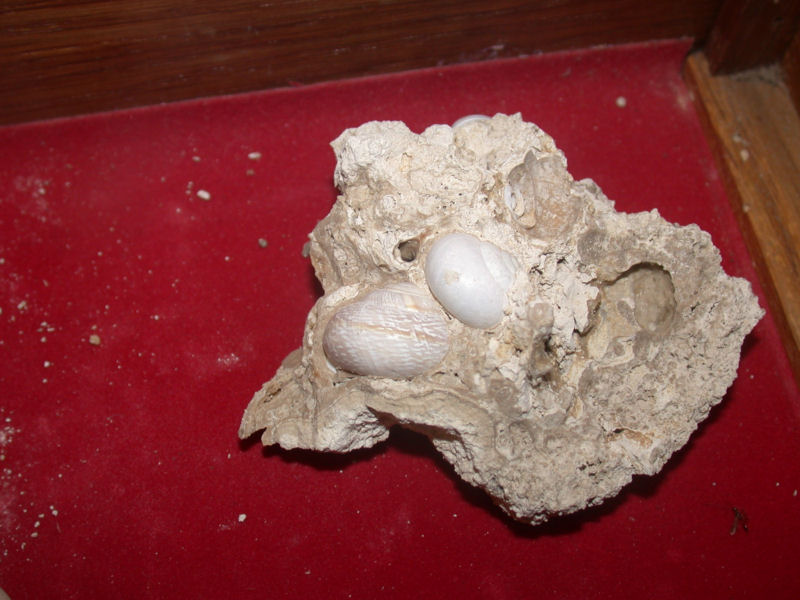
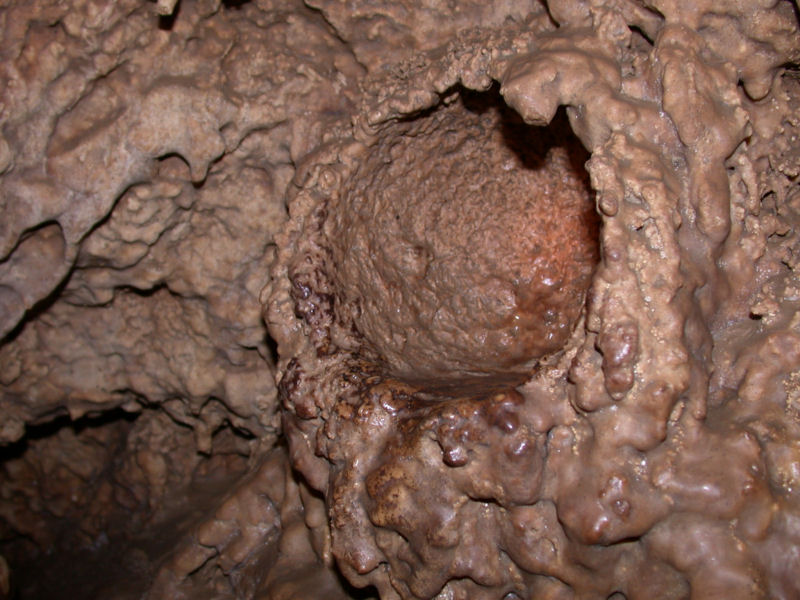
Particularly worth seeing in this cave are the various, quite young, fossils in the limestone tuff. In addition to twigs, leaves and other plant parts, there are also snail shells and a bird's nest. While shells are not fossilized, just embedded into the limestone, the other fossils are impressions of plants in the limestone. The plants are quickly covered by limestone, but the plant matter rots away and only a cavity with the structure of the plant surface remains.
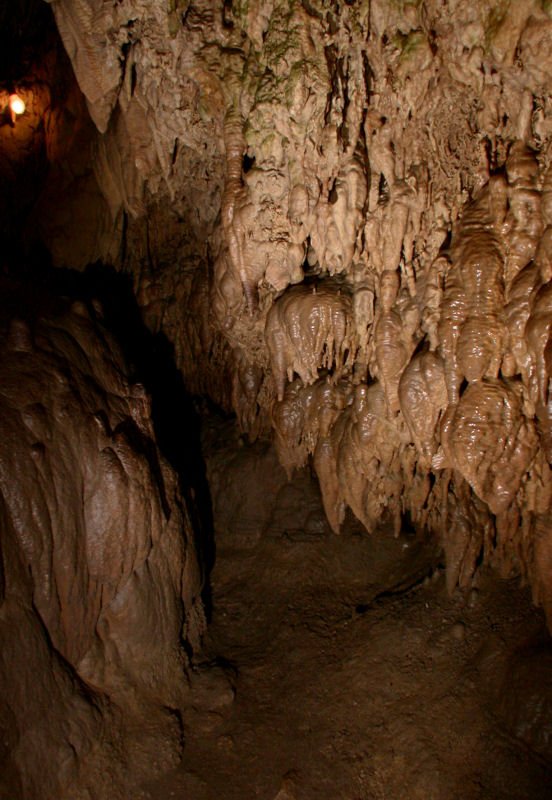
The name stalactite cave is however somewhat misleading in this case. The cave is located in calcareous tufa, and the formation of the tufa works similar to the formation of stalactites, although the result looks quite different. In the caves dripstone or cave sinter is compact and hard, consists of quite large, transparent to translucent calcite crystals. On the surface, the deposit is disturbed by mosses, algae, ferns and other plants, resulting in a porous, light and soft stone, also known as tufa. And yet there are differences, at places where few mosses grow and no plant parts are encrusted, the limestone is deposited as sinter. With karst caves, the cave passage is formed first and then stalactites grow on top of the limestone. In tufa caves the whole rock is sinter and by closing off cavities the light is excluded and plant growth is prevented, so that the deposits change into stalactite.
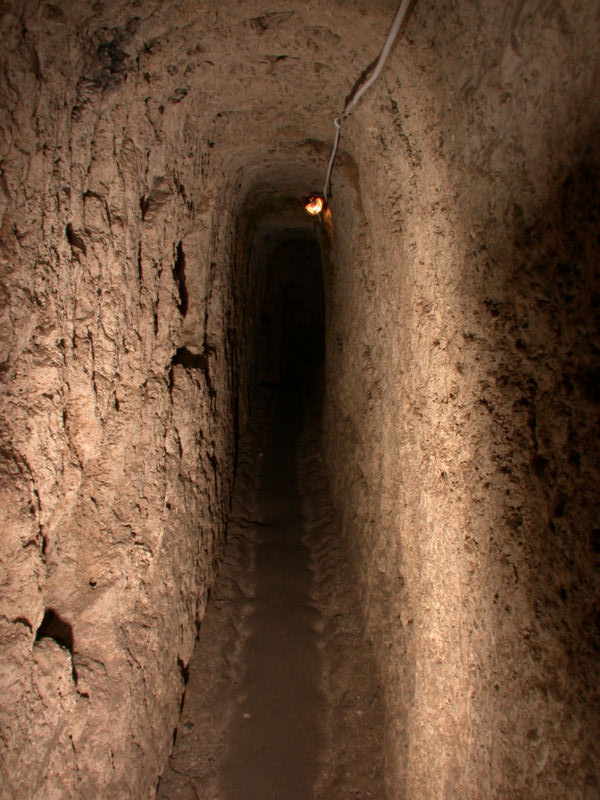
The cave was discovered by Pierre Biehl during the construction of the cellar for his restaurant, but its importance was not recognized and the entrance was filled with rubble. During the First World War, the building was destroyed and during the reconstruction of the building in 1927 by his son Willi Biehl the cave was rediscovered. He recognized the potential of the cave and explored it. Through a cross-cut he made into the soft tufa he discovered a second cave passage that runs parallel to the first one and is slightly longer. He connected both passages by a second cross-cut and was able to make a round trip. After the installation of paths and electric light he opened the cave as a show cave in 1933. He ran the cave himself and called his Restaurant zur Tropfsteinhöhle. When he retired in 1988, the restaurant was leased and he handed over the show cave to Alfred Kiefer, who continued to run it until it closed in 2014. The cave, which was still owned by Willi Biehl's widow, was sold to the Naturlandstiftung Saar in 2018. It is to be renovated and expanded to include disabled access and a media presentation. The reopening was announced for 2019, but has not taken place.
|
| Niedaltdorfer Tropfsteinhöhle Gallery |
- See also
 Search Google for "Niedaltdorfer Tropfsteinhöhle"
 Google Earth Placemark
 Niedaltdorfer Tropfsteinhöhle - Wikipedia ()
- Tropfsteinhöhle Niedaltdorf (visited: 03-NOV-2019)
- Willkommen in der Unterwelt (visited: 03-NOV-2019)
- Niedaltdorfer Tropfsteinhöhle (visited: 05-NOV-2019)
- Klein aber fein: Die Tropfsteinhöhle Niedaltdorf in Rehlingen-Siersburg (visited: 05-NOV-2019)
 Index
Index Topics
 Hierarchical
 Countries
 Maps
Maps Search