Σπηλια Καταφκι
Spilia Katafygi - Katafygi Cave - Katafygi Selinitsas - Cave of Agios Demetrios
Useful Information
| Location: |
West Mani 240 24.
Agios Demetrios, Selenitsa. Eastern coast of the Messenian Gulf. (36.8029108, 22.2974995) |
| Open: |
no restrictions. [2024] |
| Fee: |
free. [2024] |
| Classification: |
 Karst Cave
River cave Karst Cave
River cave
 Frequently Used Cave Names Frequently Used Cave Names
|
| Light: | none, bring torch |
| Dimension: | L=3,500 m, T=17-18 °C. |
| Guided tours: | self guided |
| Photography: | allowed |
| Accessibility: | no |
| Bibliography: |
Anna Petrocheilou (1984):
The Greek Caves,
ISBN 960-213-135-7, 160 pages, 135 colour illustrations.
pp 26-27 with map and photograph.
|
| Address: | |
| As far as we know this information was accurate when it was published (see years in brackets), but may have changed since then. Please check rates and details directly with the companies in question if you need more recent info. |
|
History
| 1928 | first exploration by Sarri and Georgalas, one kilometre explored. |
| 1953 | large section explored by Joannis Petrocheilos and the Swedish bio-speleologist K. Lindberg, first survey. |
| 1970 | survey of additional parts discovered during the decades by members of the Greek speleological society, total length 2,000 m. |
| 1980-1985 | explorations by cave divers from Germany, Czech Republic, and Great Britain. |
| 1999 | exploration by Greek cave divers. |
| NOV-2004 | connected with nearby Drakos spring, total length 3.5 km. |
Description
This is again one of those undeveloped caves, which is listed in many books and on websites, there is even a very detailed virtual cave on the internet. As a result many people think wrongly it was a tourist cave. Anna Petrocheilou listed it as a show cave, or at least as a cave suitable for tourists. She gives a map with a tourist path, which seems to be just the more or less level parts of the cave floor, in reality there is no trail. Probably it was a plan how a future show cave could be designed. We think that a cave of this size and with many flodded and labyrinthine passages is not really suitable to tourists. So we recommend restricting visits on the first 300 meters and to be very careful. In any case, avoid other levels and side passages. Basic security measures are good light, appropriate clothes, leaving the return time and to use your brain.
This is not the only problem with the famous book of Anna Petrocheilou concerning this cave.
It also states that there were quite famous archaeological remains in the cave, which is actually untrue.
The described archaeological remains were actually found at
 Alepotrypa,
about 30 km south.
The text tells about "numerous remains of prehistoric man like human bones and blackened pottery shards".
There is now a discussion why she published such bogus info, as she actually was a well-educated and respected speleologist.
There are two theories, one says that she tried to force the development of the cave as a show cave by making it more interesting than it actually is.
The fact that she also published it wrongly as a show cave supports this theory.
The other says that she was rather old and used 30-year-old handwritten notices from the 50s when she published the book in the 80s.
In other words it was just a mixup.
Unfortunately this bogus info was republished numerous times, even on our page.
We found out lately when the German Wikipedia page for the cave was updated.
Alepotrypa,
about 30 km south.
The text tells about "numerous remains of prehistoric man like human bones and blackened pottery shards".
There is now a discussion why she published such bogus info, as she actually was a well-educated and respected speleologist.
There are two theories, one says that she tried to force the development of the cave as a show cave by making it more interesting than it actually is.
The fact that she also published it wrongly as a show cave supports this theory.
The other says that she was rather old and used 30-year-old handwritten notices from the 50s when she published the book in the 80s.
In other words it was just a mixup.
Unfortunately this bogus info was republished numerous times, even on our page.
We found out lately when the German Wikipedia page for the cave was updated.
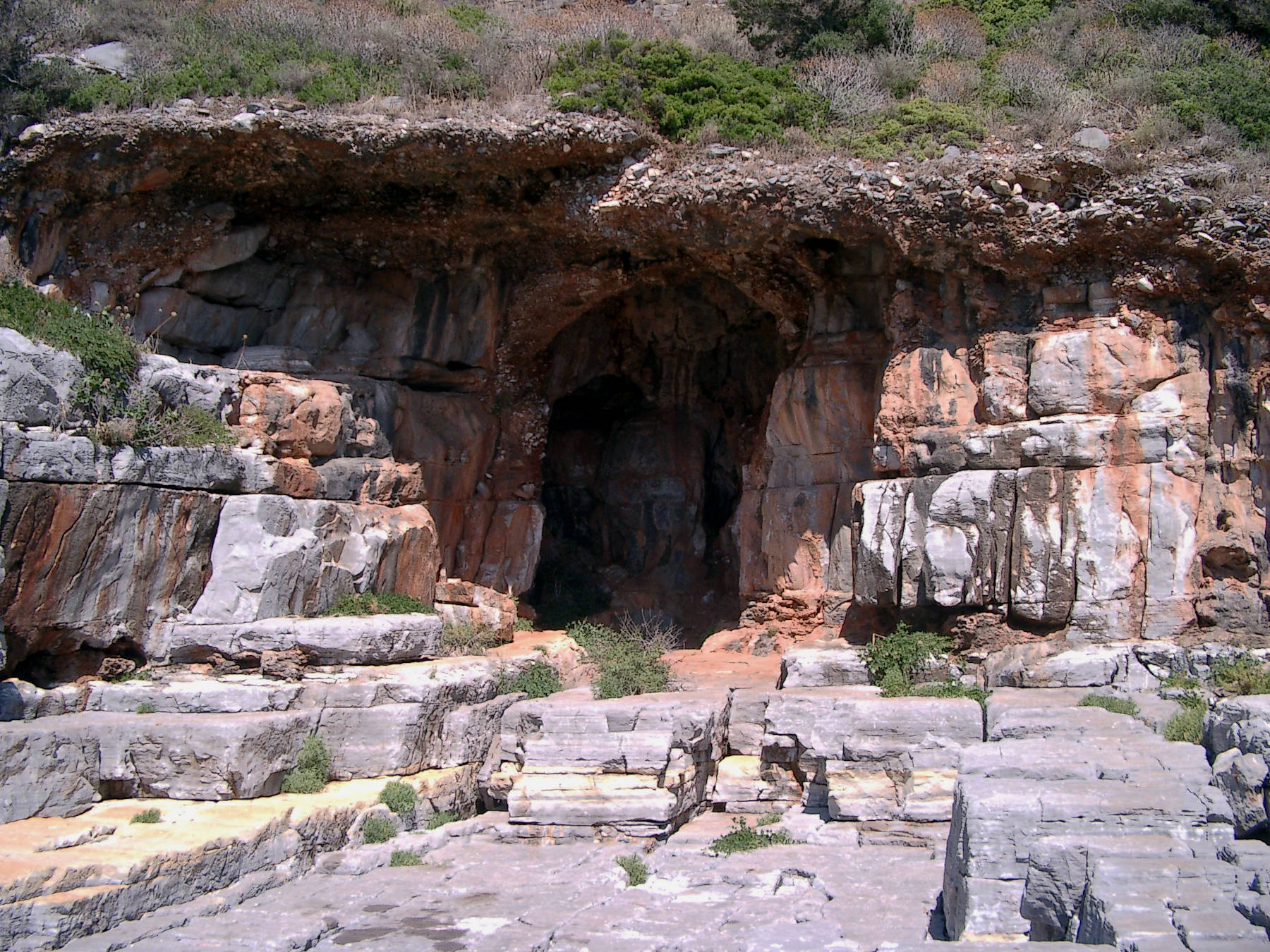

The word Καταφκι (Katafiki, Katafygi) means refuge in Greek, and this cave was one of the important hideouts in Greece. It was a refuge to man for very long, especially during the revolution. Katafygi is one of those names which are extremely common, like bat cave, bear cave, dragon cave, which exist in numerous languages and dozens of caves have this name. In Greece the name is quite popular, and there are at least five caves with that name within 40 km along the west coast of the Mani peninsula. This one is part of the Drakos-Selinitsa-System, the fourth-longest cave system in Greece [2005].
Katafygi has formed in marble limestone, and so the cave walls sometimes look a little bit like a Greek temple. The layers are slightly inclined, which gives the bay in front of the cave entrance its typical face. The cave opens right above the sea, with a nice view and a sort of marble courtyard in front, formed by a single layer of marble. The entrance is a huge portal which gives way into the main passage of the cave, a now dry river passage, which once drained the area. Today the drainage is lower, through the lower level of the cave system to nearby Drakos Spring. The cave has only very few speleothems, but those are really nice, including several rimstone pools, dogtooth spars, helictites and botryoidal stalactites. Other sights are the troglobionts found in the cave and a kind of sandbox, where visitors build all sorts of sculpures of the sand.
The cave system was originally surveyed by the Petrocheilous in 1953 for about one kilometre length. After decades of research and many diving efforts, the cave and the nearby Drakos Spring were connected. This results in a total length of 3,500 m and makes the cave the fourth-longest cave in Greece [2005]. The connection also changed the name, the cave is now officially called Drakos-Selinitsa-System and listed in the Greek cadastre under this name.
 Search DuckDuckGo for "katafygi cave"
 Google Earth Placemark
 OpenStreetMap
 Drakos-Selinitsa-System
  - Wikipedia (visited: 19-OCT-2024)
 Katafygi Cave, virtual tour with maps and many pictures by Uwe Bücher (visited: 23-FEB-2026)
 Index
Index Hierarchical
 Countries
 Maps
Maps