Pamukkale


Useful Information
| Location: |
Merkez, 20190 Pamukkale/Denizli.
22 km from Denizli, south-east Turkey. (37.923655, 29.123933) |
| Open: |
APR to SEP daily 6:30-20. OCT to MAR daily 7:30-18. [2023] |
| Fee: |
Adults TRL 200. [2023] |
| Classification: |
 Sinter Terraces Sinter Terraces
 Gateways to Hell Gateways to Hell
 Dog’s Cave Dog’s Cave
|
| Dimension: |
T=35 °C, A=500 m asl. Area: W=2,700 m L=500 m. |
| Photography: | allowed |
| Accessibility: | no |
| Bibliography: |
Ekmekci, Gunay, Simsek (1995):
Morphology of the rimstone pools at Pamukkale, Western Turkey Cave and Karst Science, Volume 22 Number 3 December 1995, BCRA. Carl Humann, Conrad Cichorius, Walther Judeich, Franz Winter (1898): Altertümer von Hierapolis Berlin: Jahrbuch des kaiserlich deutschen Archäologischen Instituts. |
| Address: |
Pamukkale, Merkez, 20190 Pamukkale/Denizli, Tel: +90-444-6893.
E-mail: |
| As far as we know this information was accurate when it was published (see years in brackets), but may have changed since then. Please check rates and details directly with the companies in question if you need more recent info. |
|
History
| 7th century BC | a temple dedicated to the mother goddess Cybele built by the Phrygians. |
| 2nd century BC | Hierapolis founded as a thermal spa. |
| 133 BC | Attalus III died and bequeathed his kingdom to Rome, Hierapolis became part of the Roman province of Asia. |
| 17 | a major earthquake destroys the city. |
| JUN-1887 | Hierapolis first excavated by the German archaeologist Carl Humann. |
| 1969 | a management plan was prepared and the area proposed as a national park. |
| 1988 | inscribed on the UNESCO World Heritage List. |
| 2016 | archaeological excavations reveal Iron Age settlement structures. |
Description
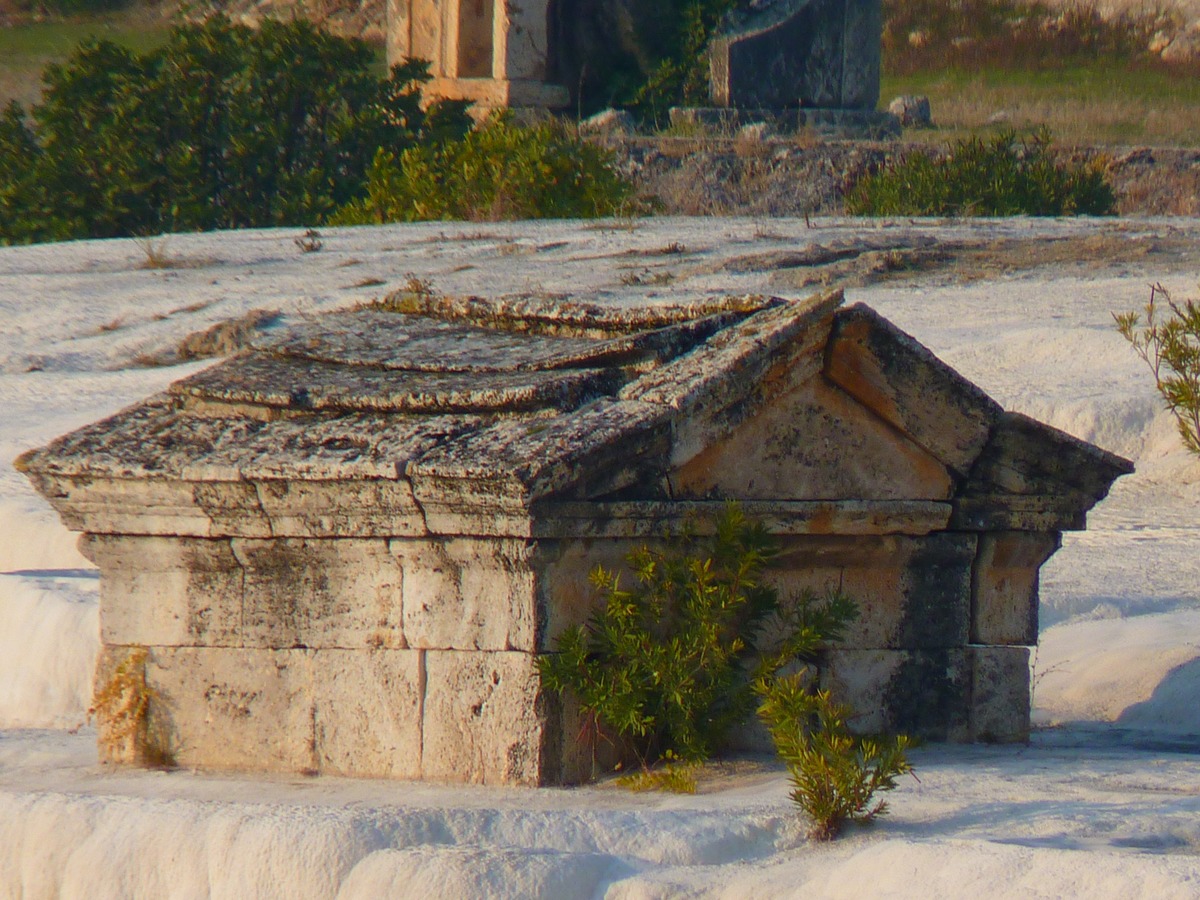

The antique city of Hierapolis was established by Eumenes II, King of Pergamon, during the second century. It was named after Hiera, the wife of Telephos, the legendary founder of Pergamon. At least that’s the most likely explanation for the name, another is that it was named after the temple (ἱερόν, hieron, holy) for Cybele around which the city developed. Hierapolis may be translated holy city. In the 2nd century BC the city began minting bronze coins which bear the name Hierapolis. The city was the capital of Phrygia during the reign of Constantin the Great.
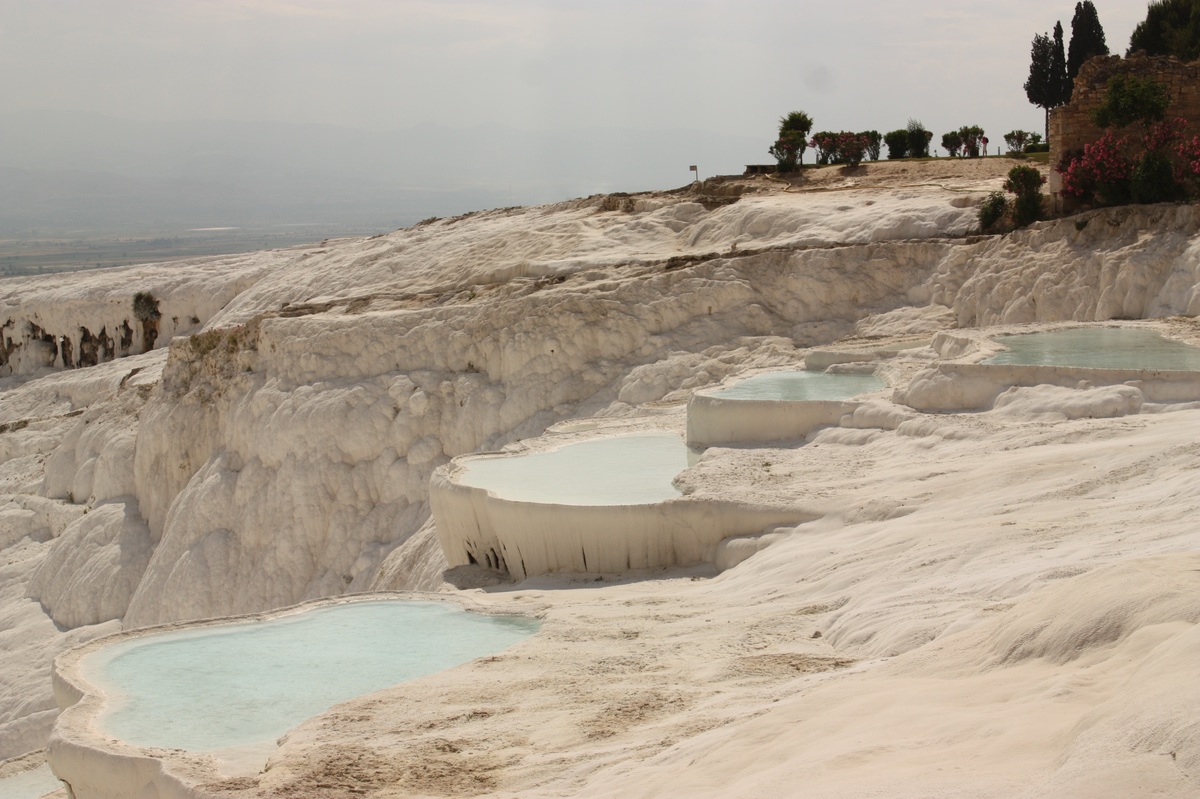
The ancient Greek city was built on top of the travertine formation, the famous
Sinter Terraces
of Pamukkale.
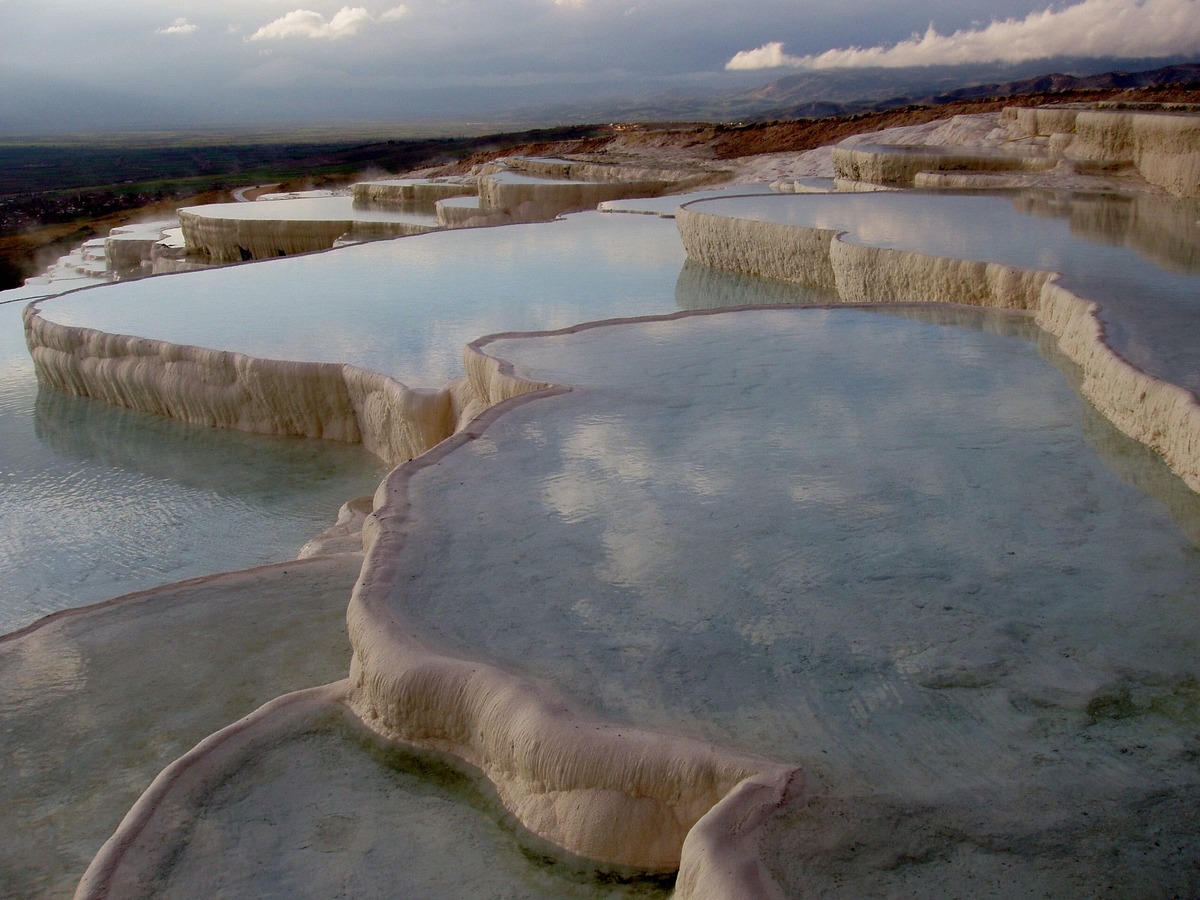
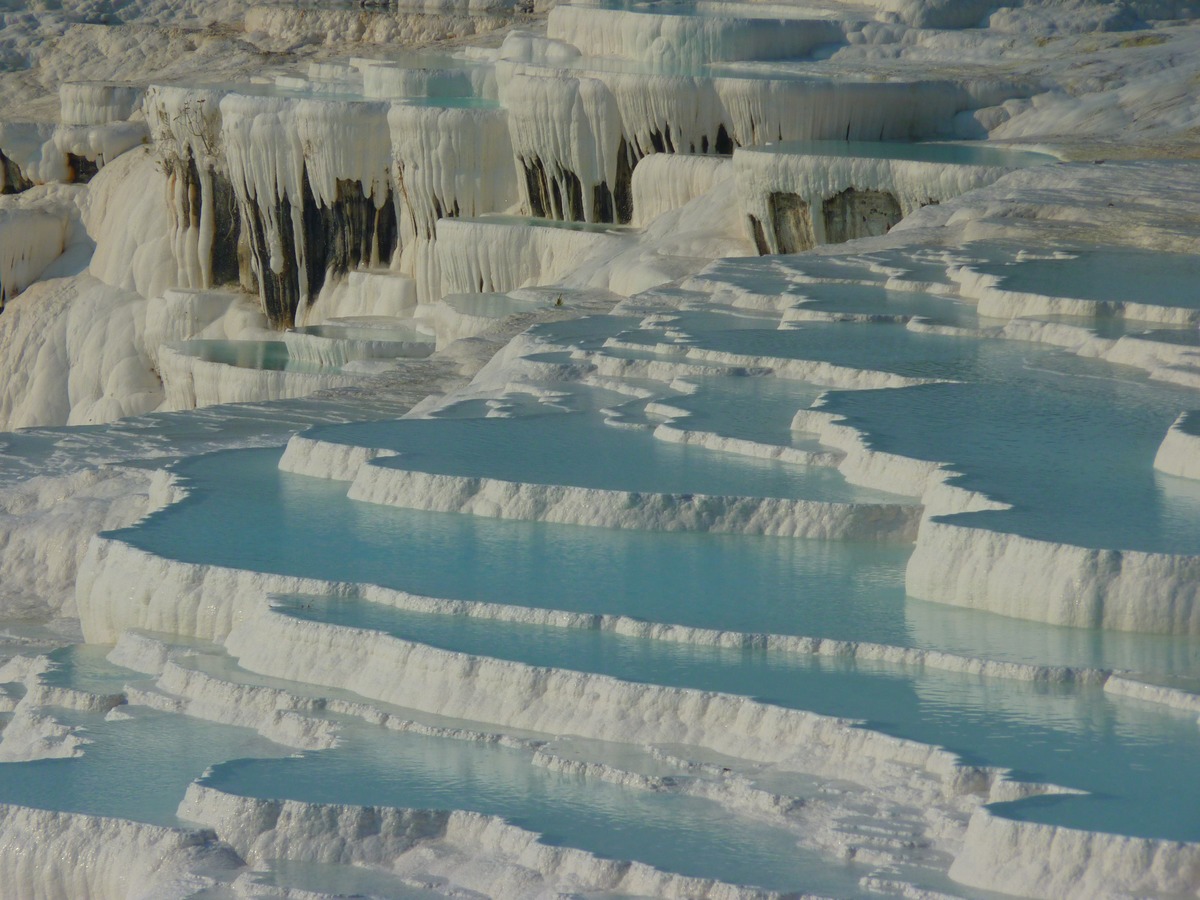
Thermal springs at the hill deposited large pools of limestone (travertine), while running down the hill.
There are 17 hot springs with temperatures ranging from 35 °C to 100 °C.
They are rather huge, making steps of 1 m to 6 m, and mostly white with minimal other colours produced by small amounts of iron oxide.
The whole formation is 2.7 km wide, the currently active part about 900 m, and goes down the hill for 240 to 300 m with a height difference of 100 m.
The deposit of travertine has reached a thickness of up to 70 m.
This massive formation is big enough to be seen from the opposite side of the valley 20 km away.
This gave Pamukkale its name, Pamukkale means cotton castle, as the white rims resemble the walls of a white castle.
The springs are located on the flat top of the hill, and so the water flows 320 m to the slope without forming terraces. Actually this platform is a direct result of the deposition of limestone, it grew from the springs by depositing at the rim. The river naturally changed its course now and then and so different parts of the whole deposit were created. Since the foundation of Hierapolis, it flows in an artificial canal and deposits on the same spot. However, thermal water flowing to the same place for a long time causes the growth of moss and therefore causes an unpleasant green colour. So the thermal water is supplied to the travertines in a controlled manner within a certain programme. When the growth of moss starts, the water is redirected and the moss dies due to the lack of water. And while this system is artificial, it actually mimics the natural situation, where the river changed its course naturally.
The hot springs have been used for therapeutic purposes for millennia. The reputation of Hierapolis stemmed from its thermal waters, its fame spread all over Anatolia during the Roman Period, and the patients came here to find healing. It is recommended for the treatment of cardiovascular diseases, blood pressure, rheumatism, rickets, paralysis, skin, eye, nervous system and vascular diseases, vascular inflammation and reyno disease. The hotels have doctors which examine the patients and determine the treatment.
The pools were intensively used for bathing, so people were actually sitting in the pools. In the late 20th century, the locals built numerous hotels on top of the terraces, similar to the ancient city, and used the thermal water for the spas inside the hotels. As a result, the water deposited the limestone in the tubes and pools of the hotels, and the wastewater with dirt, body fluids, and shampoo went down the terraces. Here it deposited only dirt, and the result was a grey misery. The site was already a UNESCO WHL site, but it decomposed rapidly. But then there were numerous protests, local and also international, and finally the government closed the hotels, set rules and forbid bathing in the natural pools. The defunct buildings were smashed down and completely removed, except for a single pool, which was part of one of those hotels. After only a few years the situation has improved greatly and the site is white again. As they grow constantly the pools regenerate, the traces of the abuse will be covered by new rock in a few years, conserved but invisible. And actually it is not necessary to damage the pools, the hotels which still have thermal pools fed by the thermal springs, are now located below the sinter terraces.
A really strange attraction from this time is the swimming pool called Cleopatra’s Ancient Pool. Located in a small park, it looks like a ruined Greek temple which was flooded. Actually it’s not, it’s all fake, the stage sets of a former hotel pool.
And while this location is actually listed for its sinter terraces, it also has a strange underground sight. Pluto’s Gate is a Πλουτώνειον (Ploutōneion, Place of Pluto), a sanctuary specially dedicated to the ancient Greek god Pluto or Hades. They were usually at locations that produce poisonous emissions and were considered an entrance to the underworld. Inhaling its vapors was said to be lethal to all living things except the Galli, the eunuch priests of goddess Cybele. It is located adjacent to the Temple of Apollo and has a small cave, just large enough for one person to enter through a fenced entrance. Behind the roofed chamber is a deep cleft in the rock, and a staircase leading down. At the bottom, fast-flowing hot water passes, releasing a sharp-smelling gas, carbon dioxide of volcanic origin. During the 4th century, the Christians filled it with stones, and it was finally rediscovered in 1965 by Italian archaeologists. In 1998, a geologist of the Italian National Research Council, Luigi Piccardi, recognized the existence of the surface trace of a seismic fault. The Ploutonion and the Apollo’s Oracle were purposely built on the fault, which was the actual Gateway of Hades. The crack was interpreted as a passage to the underworld. During ritual sacrifices, animals were thrown into the cave and pulled back out with ropes that had been tied to them.
The principle is quite simple, and has actually nothing to do with poisonous gas.
Carbon dioxide is not poisonous at all, it’s the bubbles in carbonated water, beer or champagne.
Unfortunately, we need oxygen, and so not the carbon dioxide is the problem, the lack of oxygen is.
Although this is not a cave, the term we dubbed for this kind of carbon dioxide pools is
Dog’s Cave.
- See also
 Subterranean World Heritage List
 Search Google for "Pamukkale"
 Google Earth Placemark
 Pamukkale - Wikipedia (visited: 06-APR-2023)
 HIERAPOLIS ARCHAEOLOGICAL SITE, official website (visited: 07-APR-2023)
- Pamukkale Termal Suları - Denizli
 (visited: 06-APR-2023)
 - Hierapolis-Pamukkale - UNESCO World Heritage List (visited: 06-APR-2023)
 Pamukkale Water Terraces - Atlas Obscura (visited: 06-APR-2023)
- PAMUKKALE Hierapolis Price & Hours (Updated → 2023) (visited: 07-APR-2023)
- Visit Pamukkale – Entrance, price and opening hours (visited: 07-APR-2023)
 Index
Index Hierarchical
 Countries
 Maps
Maps Search