Għar Dalam
Għar Dhalam - The Dark Cave - The Cave of Darkness - Elephant Cave
Useful Information
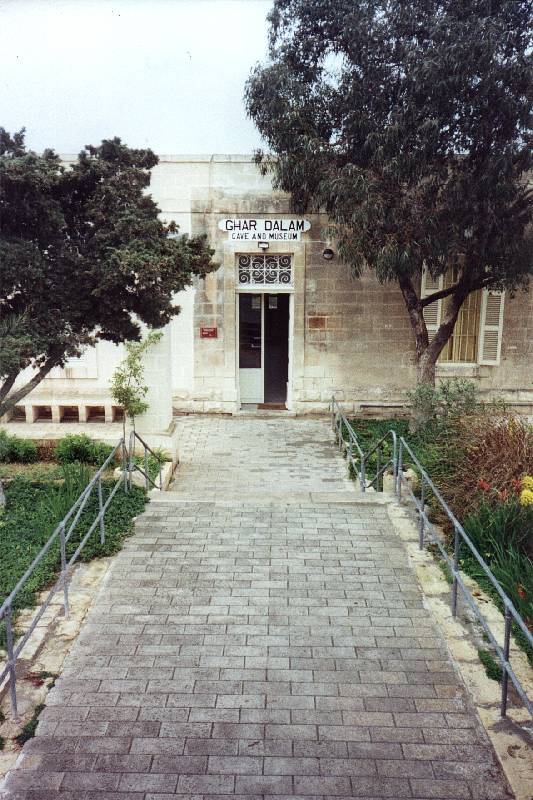
© Tony Oldham, 22-FEB-2002, with kind permission.
| Location: |
Triq Ghar Dalam, Birżebbuġa.
Birzebbugia, about 500 m from St George’s Bay. (35.8359758, 14.5276238) |
| Open: |
MAR to OCT daily 9-17. Closed 01-JAN, Good Friday, 24-DEC, 25-DEC, 31-DEC. [2024] |
| Fee: |
Adults EUR 6.50, Children (12-17) 5, Children (6-11) EUR 4, Children (0-5) free, Students EUR 5, Seniors (60+) 5, Heritage Malta Members free. [2024] |
| Classification: |
 Karst Cave Karst Cave
|
| Light: |
 Electric Light Electric Light
|
| Dimension: | L=144 m, W=18 m, H=3-6 m. |
| Guided tours: | self guided, L=50 m. |
| Photography: | |
| Accessibility: | |
| Bibliography: |
A. J. Aguis (1978):
The Guide Book to Għar Dalam Cave and Museum,
22 pp
George Zammit Maempel (1989): Għar Dalam Cave and Deposits, 74 pp 25 b & w plates, 8 figs bibliography. One of Malta’s oldest national monuments with an uninterrupted sequence of fossiliferous deposits extending from the Late Pleistocene to modern times. This book gives information on the cave, its deposits and fauna. Colour cover SB George Zammit Maempel (1989): Pioneers of Maltese Geology, 302 pp 88 illus. A biographical study of T A B Spratt, Wm Reid, A Leith Adams and J H Cooke. Many caves mentioned. Martin Morana (1987): The Prehistoric Cave of Għar Dalam, 24 pp illus. Martin Morana (1987): Die Prähistorische Höhle von Għar Dalam, 24 pp illus. 
Trevor S. Shaw (1951): Għar Dalam, Malta, BSA Cave Science, (15) pp. 304-308. Fabri Nadia (2007): Għar Dalam: The Cave, the Museum, and the Garden Birżebbuġa. Malta Heritage Books. ISBN 978-9993271444. Mario Buhagiar (2007): The Christianisation of Malta: Catacombs, Cult Centres and Churches in Malta to 1530 BAR International Series 1674, Oxford: Archaeopress, 2007, xiv + 321 pp., pbk, ISBN 978-1-4073-0109-9. DOI pdf |
| Address: |
Għar Dalam Cave and Museum, Zejtun Road, Birzebbuga BZG 05, Tel: +356-2165-7419.
Museum Officer: Ivan Bugeja, Tel: +356-21659-579. Heritage Malta Head Office (Ex Royal Naval Hospital), 35, Dawret Fra Giovanni Bichi, Il-Kalkara, KKR 1280, Tel: +356, 22-954-300. E-mail: |
| As far as we know this information was accurate when it was published (see years in brackets), but may have changed since then. Please check rates and details directly with the companies in question if you need more recent info. |
|
History
| 1647 | first desription by Fra G. F. Abela (*1582–✝1655). |
| 1865 | excavated by the Italian-German palaeontologist Prof Arturo Issel ("1842–✝1922). |
| 1892 | excavation by English teacher John H. Cooke. |
| 1902 | Forsyth Major studies the material sent to the British Museum. |
| 1922 | new scientific investigations on a larger scale by Gertrude Caton-Thompson (*1888-✝1985), a British archaeologist, and by her Maltese colleague Joseph G. Baldacchino (*1894-✝1974). |
| 1925 | included on the Antiquities List. |
| 1930 | house built at the cave entrance to store the enormous number of bones. |
| MAR-1933 | opened to the public. |
| 1935 | Dr Joseph Baldacchino appointed as curator of Natural History. |
| 1936 | exhibition hall set up by Dr Joseph Baldacchino. |
| 1937 | excavations ended after they had yielded an enormous number of animal bones. |
| 1980 | numerous valuable artefacts stolen, including four dwarf elephant tusks and the skull of a child from the Neolithic period. |
| 2002 | new museum opened to the public. |
Description
The description of Għar Dalam by Tony Oldham below is still quite informative, but it is more than 20 years old, and there have been some minor changes. First of all, the site is now operated by Heritage Malta, an organisation which has taken over all the archaeological, palaeontological and historic places on the islands. They do a very good job in preserving and operating the site. The site is now listed on multiple lists including Natura 2000, Special Areas of Conservation (SAC) of International Importance and Special Protection Areas (SPA). It is protected for a small population of endemic cave woodlouse (Armadillidium ghardalamensis) and because it is a roosting site for the Lesser Horse-shoe Bat (Rhinolophus hipposideros).
The name Għar Dalam obviously has two completely different interpretations. Some say Dalam is a fifteenth century family name, probably the owner of the land, others translate it as "darkness", so it would just mean "Dark Cave". Both explanations seem possible to us. The Darkness interpretation is simply the translation as an Arabic word, but the language spoken on the island is Maltese, which is not exactly Arabic, although numerous words are identical. The theory with the surname is from the 2007 book by Mario Buhagiar who found the surname Dalam in 15th century records. Just to make it clear, he has no information that the cave was actually named after this surname, not even a document that someone with this name lived here. So his interpretation is as much guesswork as any other.
We are not sure why Tony omitted the excavation by John H. Cooke in 1892. At this time the island was British, and while the bulk of his material was stored in Malta, a selection of items was sent to the British Museum. Ten years later, in 1902, Forsyth Major studied this material quite intensively and isolated a new species of dwarf hippopotamus (Hippopotamus melitensis). The main phase of the excavations started in 1922, when new scientific investigations on a larger scale were started by the British archaeologist Gertrude Caton-Thompson (*1888-✝1985). They were later continued by her Maltese colleague Joseph G. Baldacchino (*1894-✝1974). In 1930 the number of bones was so big, a house was built at the cave entrance to store them. Baldacchino was officially appointed curator and created a museum in this building.
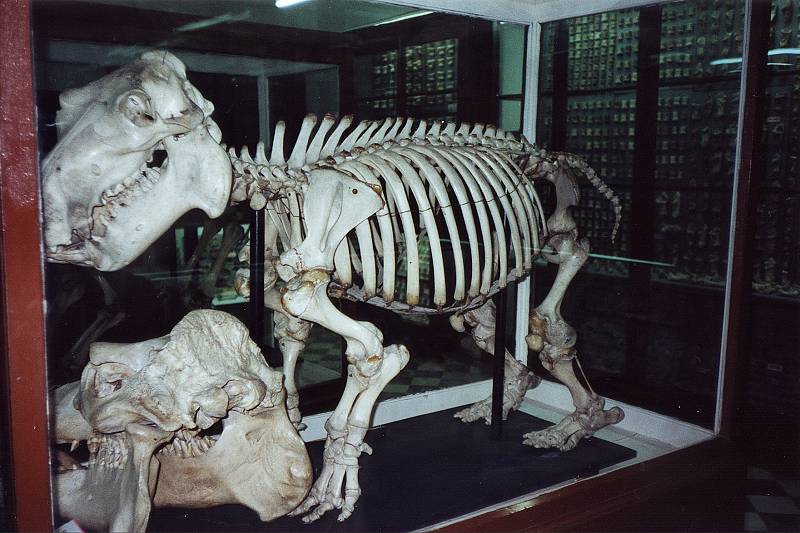
The Joseph Baldacchino Hall is the old part of the palaeontologic museum at the entrance. It is quite impressive, thousands of bones in Victorian style displays. It was named after the curator of Natural History Dr Joseph Baldacchino, who set up the first exhibition hall in 1936. This name change happened in 2002, when new museum opened to the public after its renovation and extension. The new part of the museum was named George Zammit-Maempel Hall, and presents the findings in a more didactic manner. It is named after a famous Maltese geologist and palaeontologist.
Tony only mentioned the dwarfism of the animals in a single sentence. We think it’s necessary to explain this a little more. The first excavators were quite astonished, when they found bones of elefant, hippopotamus and other mammals, which were much smaller than normal. In other words, there was a whole group of endemic animals, which evolved on the island, and all of them were much smaller than their cousins. The hippopotamus and the elephants even split into two dwarf species with different sizes. This specialty was interpreted as typical "island evolution", and the development is strongly connected with the ice ages. According to the theory, Malta was connected to Africa by dry land during the last cold age, when the sea level was more than 100 m lower. The whole area was the home to all those animals. At some point the lower land was flooded, and at some point the animals on the island were not able to leave any more. And the size of the island got smaller and smaller when the sea level rose continually. The resources shrinking over a long time are generally considered the reason why the animals became smaller, so they required less food and water.
© Tony Oldham, 22-FEB-2002, with kind permission.
© Tony Oldham, 22-FEB-2002, with kind permission.
© Tony Oldham, 22-FEB-2002, with kind permission.
The cave is accessed through the Museum which contains a fascinating collection of bones together with an interesting reconstruction of the extinct dwarf elephant Elephas falconeri, which was just over a metre high when fully grown. From the museum, a paved foot path 150 m long, which descends 50 steps, leads to the cave entrance.
Għar Dalam [pron ahr DAH-lam] is noted for its place in Maltese prehistory because it contains an uninterrupted sequence of fossiliferous deposits extending from the Late Pleistocene to Modern times, a period of 130,000 years. The Neolithic Age 5000 to 4500 BC is represented by pottery. The cave was one of the sites used by early man who crossed to the Maltese islands from Sicily via a land bridge around 5000 BC. Even more remarkable than the evidence of prehistoric man was the discovery of thousands of fossilised animal bones. The cave was first described by Fra G F Abela in 1647 [Maempel p 254] and excavated in 1865 by the Italian-German palaeontologist, Prof Arturo Issel. Issel had to eject the farmers who were using the cave as an improvised cattle pen. Excavations revealed that the floor of the cave had five different layers. In the lower layers were enormous quantities of fossilised bones, tusks and teeth belonging to extinct species - such as dwarf elephants and dwarf hippopotami - along with red deer (Cervus elaphus), brown bear (Urus actus), wolf (Canis lupis), fox (Canis vulpes) and giant swan (Cygnus falconen). As these are all animals associated with Europe this is proof that Malta was once connected to the European mainland rather than the African mainland.
It is suggested that a rise in sea level stranded these large mammals on the island and that the lack of food caused the dwarf versions to evolve. In the upper layers archaeologists found flint tools, sling-stones and pottery which had been decorated by using the rippled edge of sea shells or by pointed sticks or bones. Interest in the unique faunal remains in this cave means that the site is known internationally.
Long before archaeologists took any interest in this site, the remains of other prehistoric animals had been discovered elsewhere on the islands. In the distant past local Maltese believed they were the bones of the giants who were supposed to have built the island’s megalithic temples.
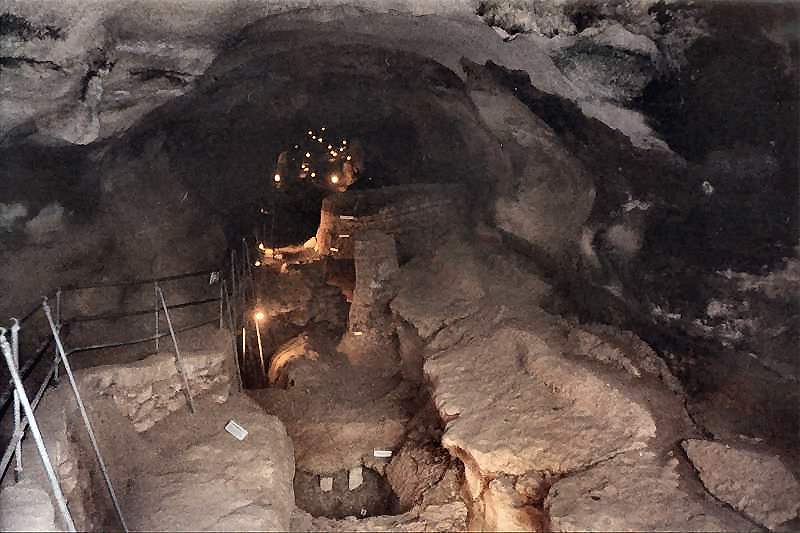
The Għar Dalam show cave is entered via a wide, low phreatic tube, about 10m in diameter which cuts 140 m into the Lower Coralline Limestone, however, this entrance has been considerably enlarged by the above mentioned excavations. Most of the remains were found near the entrance, very little being found further in the cave.
The cave consists basically of a single passage about 140 m long and 7 m wide, of which 80 m is accessible to the public. There is considerable breakdown in the cave, with blocks having fallen from the roof, so much so that a path has had to be excavated to allow visitors to pass through. Beyond the 80 m point the cave branches into three passages which take the shape of funnel shaped chambers and tunnels all of which are considerably smaller than the main gallery.
Large dry stalactites and stalagmites up to 60 cm across occur in considerable quantities. These must have formed before the bones were deposited, as they bisect the bone bearing deposits, a factor which has protected the formations.
Although the cave is electrically illuminated, most of the tourist section can be viewed using natural daylight.
Notice boards tell the visitors what has been discovered there.
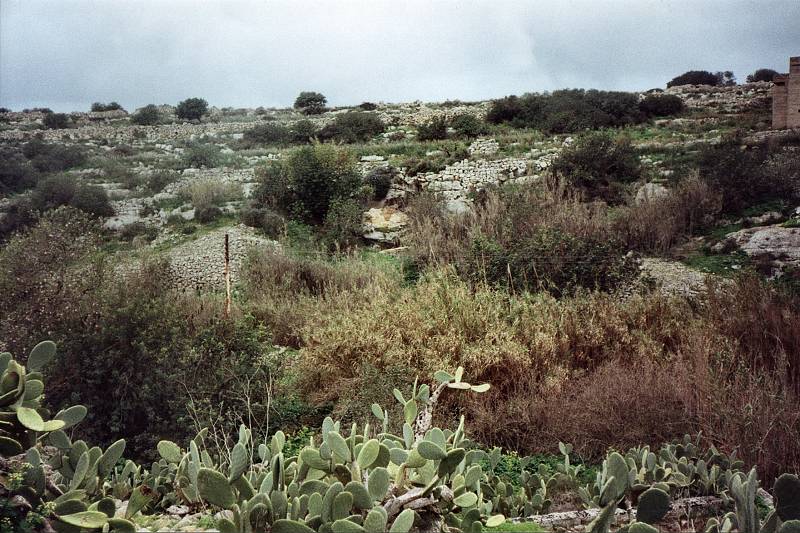
In the excavations you can still see layers of bone deposits. It is possible that this cave is part of a much larger system which has been bisected by the downcutting of the valley and a small, blocked, opening is still visible on the opposite side of the valley to the cave which lends credence to this theory, as it seems to have developed in the same joint.
Text by Tony Oldham (2002). With kind permission.
- See also
 Search DuckDuckGo for "Ghar Dalam Cave"
 Google Earth Placemark
 OpenStreetMap
 Għar Dalam - Wikipedia (visited: 21-AUG-2024)
 Għar Dalam (visited: 21-AUG-2024)
- Malta’s first inhabitants (visited: 21-AUG-2024)
- YouTube - MALTA: Ghar Dalam (Cave of Darkness or Elephant Cave) (visited: 21-AUG-2024)
 Għar Dalam - Atlas Obscura (visited: 21-AUG-2024)
 Index
Index Topics
 Hierarchical
 Countries
 Maps
Maps