Mellieħa Cave and Spring
Useful Information
| Location: | Near Mellieħa. |
| Open: | no restrictions |
| Fee: | free |
| Classification: |
 Karst cave Karst cave
|
| Light: | |
| Dimension: | |
| Guided tours: | |
| Photography: | |
| Accessibility: | |
| Bibliography: | |
| Address: | |
| As far as we know this information was accurate when it was published (see years in brackets), but may have changed since then. Please check rates and details directly with the companies in question if you need more recent info. |
|
History
| 1862 | excavated by T A B Spratt. |
Description

© Tony Oldham, 23-FEB-2002, with kind permission.
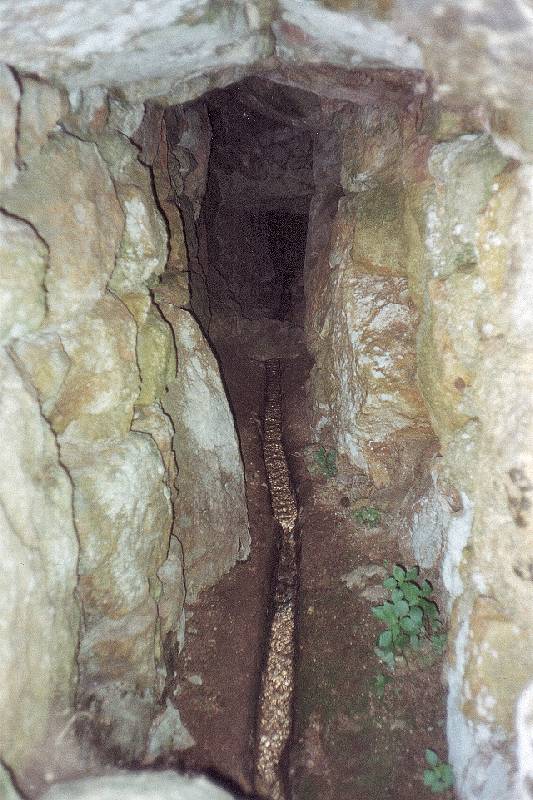
© Tony Oldham, 23-FEB-2002, with kind permission.
In the Upper Coralline Limestone near the village of Mellieħa and about 60 m [some accounts give 200 m north] north of the chapel. Overlooking and about 90 m above the sea, the cave contained stalactites, stalagmite floors and water worn-pebbles. The cave was originally discovered and destroyed in the 1840's when constructing a road to the Cemetery. Its contents were used as rubble to fill up the interstices in the wall and undoubtedly also for road construction. Excavated by T A B Spratt in 1862 who found Pleistocene bone deposits containing Hippopotamus.
To the south of the village of Mellieħa are a series of limestone outcrops honeycombed with caves. Most of the caves have been adapted in some way, originally for habitation but today their use is mainly agricultural. At the side of the No 1 Gozo to Valetta trunk road, about 2 km south of the village is a double 'S' bend in the road. Park in the layby and seek permission from the nearest allotment holder. A path leads to one of the largest cave entrances over 20 m high but blocked by a two storey building, a miniature Predjama! There are more caves with entrances partially blocked with dry stone walls on the opposite side of the valley. In the valley floor there is a spring with a long line of stone runnels leading water into a tank. A scene unchanged since Roman times.
Overlooking the town there is: The Shrine of Our Lady of Mellieħa - the Grotto. A descent of about 70 steps leads to an underground spring in the heart of the cave. The water is said to have miraculous powers healing the diseases of children. It houses an amazing icon of the Madonna attributed by tradition to St Luke, and all around the rock walls are covered with votive gifts.
Text by Tony Oldham (2002). With kind permission.
- See also
 Search Google for "Mellieħa Cave"
 Index
Index Topics
 Hierarchical
 Countries
 Maps
Maps Search