غار علی صدر
Ghar-e-Ali Sadr - Ghar Ali Sadr - Ali Sadr Cave
Useful Information
| Location: | Village of Alisadr, district of Kabudrahang. 80 km northwest of Hamadan, 350 km east of Teheran. Buses from Teheran to Hamadan and from Hamadan to Ali Sadr Cave. |
| Open: | |
| Fee: | Adults 2000 Rial |
| Classification: |
 Karst Cave Karst Cave
|
| Light: |
 Incandescent Incandescent
|
| Dimension: | L=11,440 m, VR=40 m, A=1,500 m asl, T=11.5 °C. |
| Guided tours: | L=1,400 m, by boat. V=400,000/a [2000] V=80,000/a [2006] |
| Photography: | |
| Accessibility: | |
| Bibliography: |
E. Fritsch (1995):
Höhlen in Persien,
Mitteilungen des Landesvereins für Höhlenkunde in Oberösterreich; 41(1); 57-62; Linz
( ) )
Pete Szablyar (1988): Ali Sadre-barlang (Iran), Karszt es Barlang 1988(2):113, Budapest. (  ) )
Georg Kaufmann, Michael Laumanns, Thilo Müller (2001): Iran - Ghar Ali Sadr, Mitteilungen des Verbandes der deutschen Höhlen- und Karstforscher, Nr. 2/2001, Jg. 47 ( )
M. Laumanns, S. Brooks, I. Dorsten, G. Kaufmann, M. Lopez-Correa, B. Köppen (2001): Speleological Project Ghar Alisadr (Hamadan/Iran), Berliner Höhlenkundliche Berichte, Volume 4, 43 pp, many b&w-photos and surveys, annexes, Speläoclub Berlin, Berlin 2001, ISSN 1617-8572 |
| Address: | |
| As far as we know this information was accurate when it was published (see years in brackets), but may have changed since then. Please check rates and details directly with the companies in question if you need more recent info. |
|
History
| ~500 | B.C. artificial entrance tunnel into the cave built. |
| ~1960 | discovered by a local shepherd looking for a lost goat. |
| 1963 | explored by Iranian mountaineers. |
| 1978 | discovered by an inhabitant of Ali Sadr. |
| 1994 | new parts of the cave discovered but not surveyed. |
| DEC-2000 | a German expedition, Dr. Georg Kaufmann, Michael Laumanns, and Thilo Müller surveyed most of the cave. |
Description
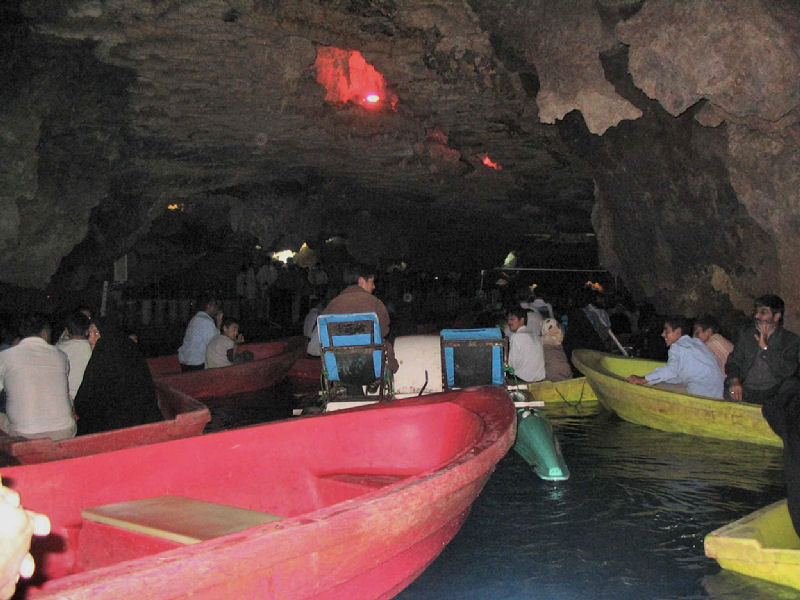
Ali Sadr is a water cave, most of the trip is done by boat. But the cave is not a typical river cave with a flowing river, the water is more like a very long lake and crystal clear. Of course the cave shows many formations, but the standing water also allowed the growth of calcite crystals on the walls. They are 5 to 10 cm in size and cover the walls under water and up to about 3 m above todays water level.
Ali Sadr has 400,000 visitors per year (1994), which makes it one of the most visited cave of the world.
For a comparison: the famous
 Postojnska Jama
had about 1,000,000 visitors per year in the eighties, the
Eisriesenwelt
has about 200,000 visitors per year.
Because of the political situation and the difficulties to visit the country, the visitor must be from the Iran, not from abroad.
Ali Sadr Cave is located between huge cities like Hamadan, Teheran, Qom and Bakhtárán.
And as far as we know, it is the only show cave in the Iran.
This may explain the enormous number of visitors.
Postojnska Jama
had about 1,000,000 visitors per year in the eighties, the
Eisriesenwelt
has about 200,000 visitors per year.
Because of the political situation and the difficulties to visit the country, the visitor must be from the Iran, not from abroad.
Ali Sadr Cave is located between huge cities like Hamadan, Teheran, Qom and Bakhtárán.
And as far as we know, it is the only show cave in the Iran.
This may explain the enormous number of visitors.
The 1994 new discovered parts of the cave are said to be enormous. But all older publications of a length of 11 km were just a rumour. The number based on a very vague appraisal. In December 2000 a German expedition started a completly new, state of the art, survey. This survey was completed by a German/British expedition in summer 2001 and the result was by coincidence really 11 km. This made Ali Sadr the longest (surveyed) cave of the country, at least until the next cave was surveyed. The main chamber is 100 to 50 m big and 40 m high, the second largest is not much smaller.
For a very long time, the cave was a water reservoir for the people in nearby village Ali Sadr. The artificial entrance tunnel to the cave was built during the reign of Dareios I. (521-485 B.C.), King of the Araemenides. At least this is what an old inscription at the entrance tells. This tunnel leads the water to the surface.
The cave is known to the people for a very long time. However, most of this knowledge was lost, and so the cave was rediscovered in 1978, when the water from the spring diminished. An inhabitant of Ali Sadr followed the tunnel in search for the water. Another story tells, the cave was rediscovered already in 1960 by a local shepherd looking for a lost goat.

|
| Ali Sadr Cave Gallery |
- See also
 Search Google for "Ali Sadr Cave"
 Google Earth Placemark
 Ali Sadr Cave - Wikipedia
 Speleological Project Ghar Alisadr (Hamadan/Iran) abstract
- Publications of the Speläoclub Berlin (SCB)
- Al Hoota Cave - Home (visited: 16-JUN-2011), official website.
- Ali-Sadr Cave (image)
- The boat landing in Ali-Sadr Cave (image)
- Ali Sadr ( Alisadr ) Cave Photo Gallery by Ali Majdfar at pbase.com gallery.
- The world’s largest water cave - Tehran Times (visited: 09-AUG-2016)
 Index
Index Topics
 Hierarchical
 Countries
 Maps
Maps Search