Creswell Crags
Creswell Crags Museum & Prehistoric Gorge
Useful Information
| Location: |
Welbeck, Nottinghamshire.
B6042 (Crags Road) between the A616 and A60, 2 km east of Creswell village. (53.263491, -1.193529) |
| Open: |
Visitor Centre: FEB daily 10-16:30. MAR to SEP daily 10-17. OCT daily 10-16:30. NOV to JAN Sat, Sun 10-16:30. Caves: School holidays daily 11:30, 13:30, 15. SEP to OCT Sat, Sun 11:30, 13:30, 15. NOV to JAN Sun 11:30, 14. [2021] |
| Fee: |
Parking: 3 h GBP 4, full day GBP 6. Visitor Center: free. Exhibition: Adults GBP 3, Children (0-15) free, Students GBP 2, Seniors (60+) GBP 2. Cave Tour: Two Persons GBP 30, Additional Person GBP 10. Cave Tour Package: Per Group GBP 10. [2021] |
| Classification: |
 Karst Cave
Permian (Zechstein) limestone Karst Cave
Permian (Zechstein) limestone
 Gateway to Hell Gateway to Hell
|
| Light: |
 Incandescent Incandescent
|
| Dimension: | |
| Guided tours: |
Life in the Ice Age Tour: Max=6, MinAge=5. Witch Marks Tour: Max=6, MinAge=5. Rock Art Tour: Max=4, MinAge=5. |
| Photography: | |
| Accessibility: | no |
| Bibliography: |
Anon (ND 2002?):
Creswell Crags,
Visitor Guide by oakleaf-graphics. 16 pp, many colour photos. SB
Anon (ND, 2002?): Walking in the Creswell Limestone Area, Creswell Heritage Trust, 12pp. Five walks, five maps. SB W Boyd Dawkins (1880): Early Man in Britain, 537 pp 168 figs. This is the companion volume to Cave Hunting, and goes into greater detail. There are good accounts of the caves of Cresswell Crag, Castleton [Derbyshire] Pont Newydd [North Wales], the caves of Somerset, S Devon etc. A scarce item. Original publishers binding. Picture spine gold block etc. Some wear, on spine o/w G. HB Tony Waltham (1984): Caves, crags and gorges, A guide to limestone country in England and Wales. Creswell Crags pp 245 - 249 Arthur Smith Woodward (1914): On an Apparently Palæolithic Engraving on a Bone from Sherborne (Dorset), Quarterly Journal of the Geology Society April 1914. online |
| Address: |
Creswell Crags Visitor Centre, Crags Road, Welbeck, near Worksop, S80 3LH, Tel: +44-1909-720378
E-mail: |
| As far as we know this information was accurate when it was published (see years in brackets), but may have changed since then. Please check rates and details directly with the companies in question if you need more recent info. |
|
History
| 1870 | exploration of Creswell Crags began. |
| APR-2003 | three archeologists discovered prehistoric cave art in Church Cave. |
| 2009 | new exhibition building. |
| 2017 | marks in walls and ceilings identified as witch marks by Hayley Clark and Ed Waters from Subterranea Britannica. |
Description
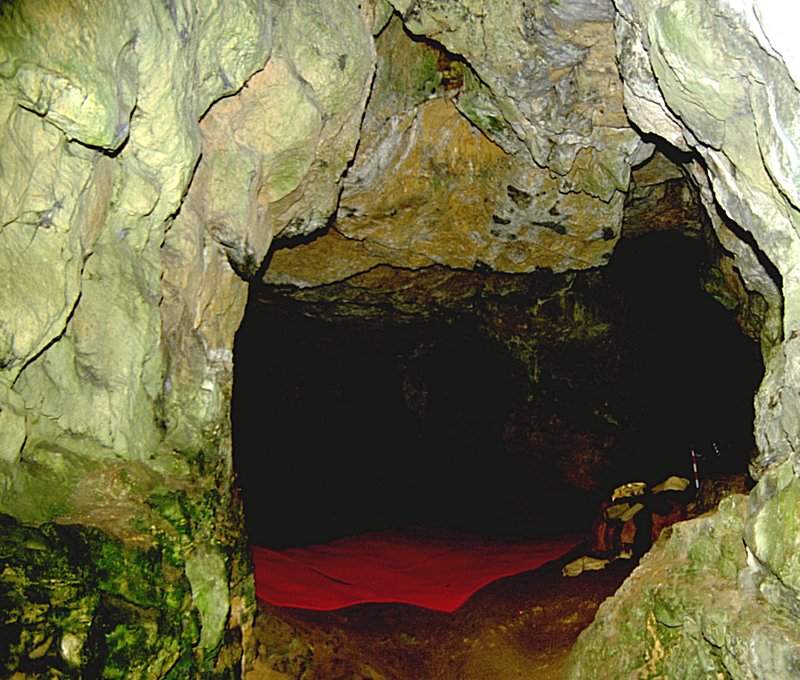
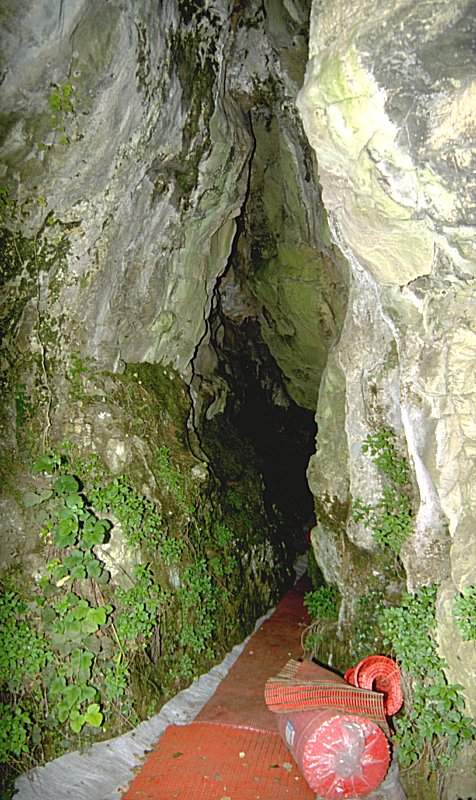
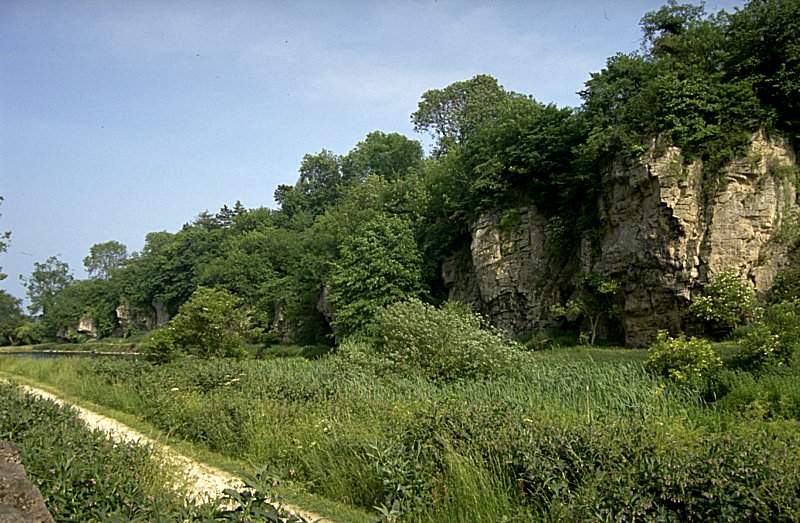
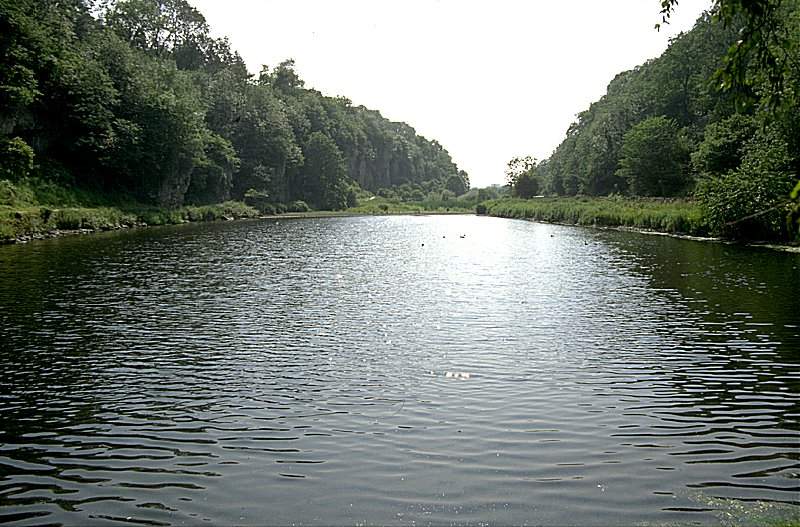
Creswell Crags is an ensemble of several small caves along both sides of a small valley. The valley was eroded through the limestone hill by a small river and is about 500 m long. Today the floor of the gorge is covered by a large lake, which is artificial and was created by a dam. The homonymous crags are numerous small and narrow caves on both sides of the valley.
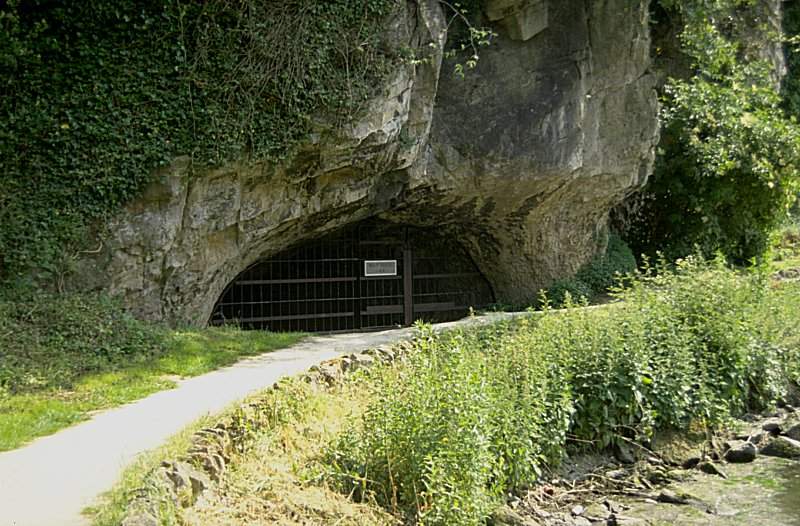
A footpath from the visitor centre at the upper end of the gorge leads along the limestone cliffs. At the lower end the path crosses the road and leads back up on the other side. So it is possible to visit all the caves known as Robin Hood’s Cave, Churchhole, Grundy’s Parlour or Pin Hole. The caves are protected by metal grills to preserve them, but the grills allow at last a glimpse of how the caves look like. There are regular tours from the visitors centre into Robin Hood’s Cave.
These caves and the hidden valley were used as shelter by Ice Age man. The excavations in the last century showed remains of Neanderthals and modern humans, Ice Age animals and rare engravings. Unfortunately the Victorian archaeologists did not use the modern techniques for excavation and documentation. So on their hunt for spectacular finds a lot of information, the crags could have provided was destroyed forever.
The oldest remains in Creswell Crags are 43,000 years old Neandertal stone tools, and there is evidence of Neanderthal occupation 50,000–60,000 years ago. It is the most northerly place in the world with Neandertal remains. The idea is, that Neanderthals, living in southern England and northern France, walked into the north, towards the edge of the glacier, to follow the deer herds during summer. They stayed here only a few weeks until they had to return south. And the whole journey was possible only because of the much lower sea level. The channel between England and France was land during most of the last Ice Age, because the sea level was up to 100 m lower than today. But most of the visits are dated to have happened much later, between 30,000 and 12,000 years ago.
This site is very important for archaeology, a Paleolithic (Old Stone Age) culture of Britain was named after the type locale (locus typicus) at Creswell Crags. The Creswellian was named in 1926 by Dorothy Garrod. Together with the Hamburgian it actually belongs to the Late Magdalenian. The Creswellian is dated between 13,000 and 11,800 BP, and ends with the Younger Dryas, which was a cold phase during which Britain was uninhabited.
Later this place was visited by modern man, for example the caves were used during Celtic Times, Roman Times, and the Middle Ages. But the story, that Robin Hood found shelter in these caves, is just a legend. No Robin-Hood-remains were found during excavations...
In April 2003 a new discovery was made, the first discovery of Palaeolithic cave art in Britain. In Church Cave three archaeologists, Paul G. Bahn, Paul Pettitt and Sergio Ripoll, discovered engravings which seem to be Paleolithic. These are the first engravings ever found in Britain, there were only figurines and other portable art of this period excavated before. Engravings are extremely difficult to see, you need a trained eye and advantageous lighting. They are not colourful, and only visible if the shadow falls from the right direction. Nobody had ever combed the British caves in search of engravings, so the three scientists made a survey and discovered engraved marks inside a great number of caves. Here at Creswell Crags, they found both figurative and non-figurative engravings of the period. They have been systematically investigated and the results are published by now.
In 2017 some markings on the wall of Robin Hood Cave were identified as so-called witch-marks or witches’ marks, which were long known, but wrongly interpreted as Victorian graffitti. When Hayley Clark and Ed Waters from Subterranea Britannica participated at a regular cave tour, they recognized them as Apotropaic marks. Apotropaic derives from the Greek word apotrepein which means to turn away. Created between the 16th and 18th century, they were symbols to guard against evil witches during a time when there was widespread belief in witchcraft. The eerie markings of hundreds of letters, symbols and patterns, so far more than a thousand were identified, were carved into the walls and ceilings of all caves. The number and variety of designs is unprecedented. Robin Hood Cave has more Witch Marks than anywhere else in the UK. The place with the second-most number of such marks is a cave in Somerset with only 57. Such protection marks are also found in medieval churches and houses, near the entrance points, particularly doorways, windows and fireplaces.
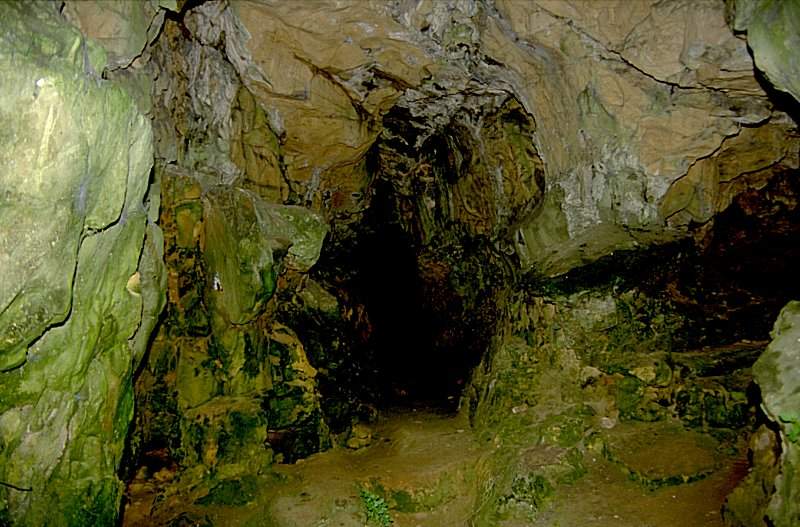
Some marks reference Jesus and Christianity, while others looking like boxes and mazes are believed to be traps for evil. They were carved in the depths of the cave to keep away evil spirits. Especially around a one-metre round hole into sheer darkness which was obviously thought to be a connection to something extremely evil. They obviously thought, whatever was inside, was so powerful that they had to keep adding more and more marks. You can obviously call it a gateway to Hell, or to the untamed non-human land of fairies, witches, or other supernatural forces. The Witch Mark Tour focuses on those marks.
There are three tours at Creswell Crags. The Life in the Ice Age Tour and the Witch Mark Tour enter Robin Hood Cave, the largest of the caves on site. The Life in the Ice Age Tour explains how life would have been like for the early humans who took shelter in the caves. The Rock Art Tour shows the most important Ice Age rock art in Britain in Church Hole Cave. This tour is not offered during winter for bat protection. And before you ask: no, bats do not roost during winter, they hibernate during winter. A rather funny mistake on the official website, actually. The tours are offered during open hours at various times, online booking on their website is required. Visitors are equipped with helmets and headlamps, good walking shoes and a jacket are much recommended. Please arrive at the reception desk at least 15 minutes before the tour.
 Excerpt from W B Dawkins (1880): Early Man in Britain
 Search DuckDuckGo for "Creswell Crags"
 Google Earth Placemark
 Creswell Crags - Wikipedia (visited: 06-JUL-2021)
 Creswell Crags, official website (visited: 06-JUL-2021)
 Index
Index Hierarchical
 Countries
 Maps
Maps