Karst Spring
spring
a natural resurgence of groundwater, usually along a hillside or from a valley floor.
Natural flow of water from the ground or from rocks, representing an outlet for the water that has accumulated in permeable rock strata underground.
perennial spring
a spring that flows continuously.
intermittent spring
a spring alternately containing and empty of water.
periodic spring
a spring having or marked by repeated cycles.
karst spring
a spring in a karst area, its behaviour is a result of the geometry of the cave behind.
alternative.
Adjective used to designate an intake or resurgence operating only during rainy seasons; in some areas reversible; equivalent to intermittent
emergence.
Point at which an underground stream comes to the surface.
See also exsurgence; resurgence; rise.
exsurgence.
Point at which an underground stream reaches the surface if stream has no known surface headwaters.
See also emergence; resurgence.
resurgence.
Point at which an underground stream reaches the surface and becomes a surface stream.
In European literature, the term is reserved for the reemergence of a stream that has earlier sunk upstream.
The term exsurgence is applied to a stream without known surface headwaters.
Watson Hiner Monroe (1970): A Glossary of Karst Terminology, Geological Survey Water-supply Paper 1899-k, Library of Congress catalog-card No. 75-607530
DOI
online
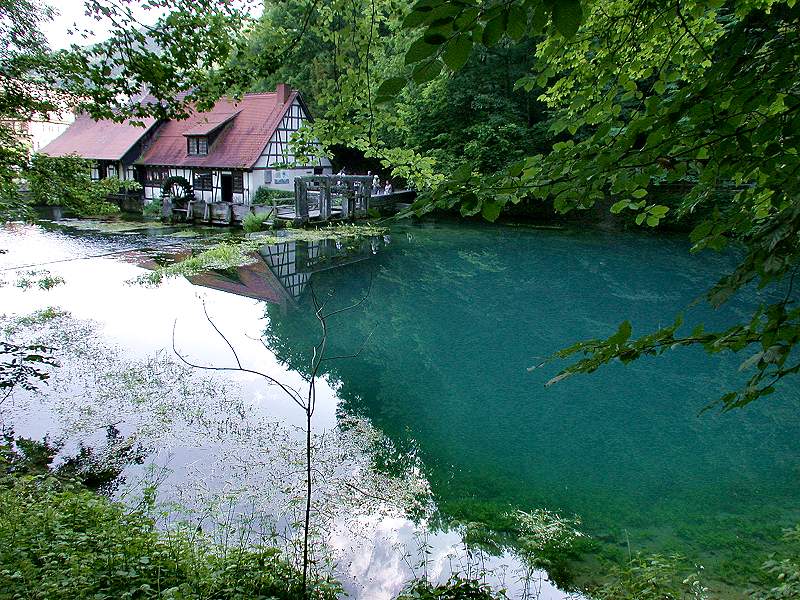
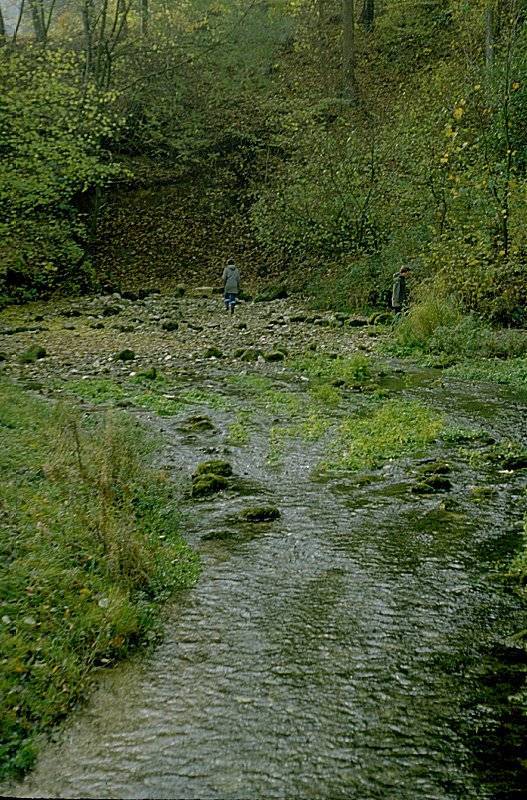

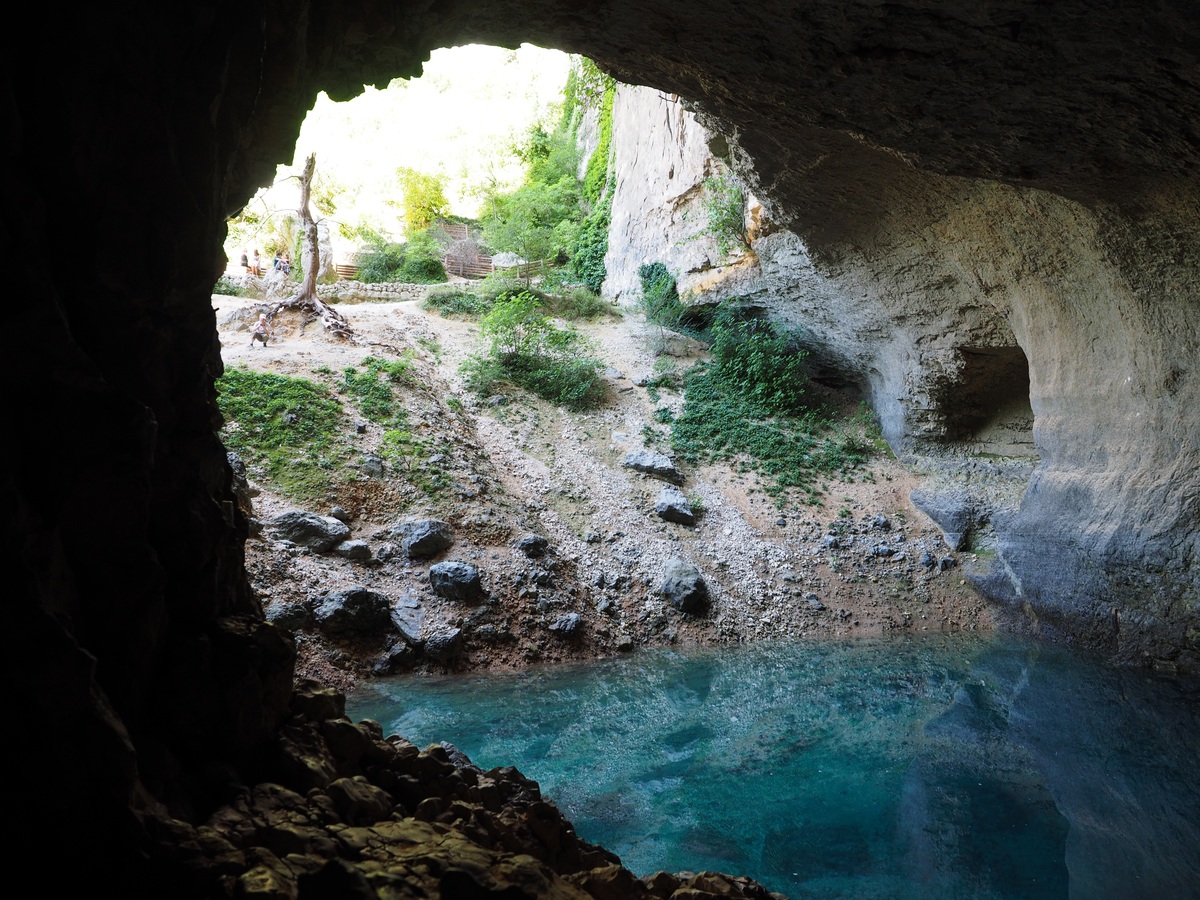
Karst springs are springs that are fed from karst areas. Cave springs, i.e. springs inside caves, are not called karst springs. Springs in karst areas differ from other springs because they are the end of a water-filled cave system:
- They normally have a much higher yield or discharge.
- They are highly dependent on the weather, every heavy rain and, of course, the snow melt leads to increased yield.
- Karst springs regularly fall dry in dry periods, e.g. during the summer, such springs are called
 Seasonal Spring.
- Karst springs are not a good source for water supply. The water is often quite shortly underground, and when it reappears it is not sufficiently cleaned by filter materials or bacteria.
- Each source is assigned a catchment area, which is determined by dye tracing tests with special dyes or salt.
The strong differences in the flow of a karst spring and the poor water quality are obviously related to the characteristics of the catchment area, i.e. the karst area. The water percolates on the surface through crevices, thus quickly entering cave systems and flowing downhill in crevices and caves (river caves) similar to a stream. This results in a very high velocity, especially compared to flowing through pore spaces. The water is only in the mountain for a few days, the microorganisms responsible for purifying the groundwater in sand or gravel have too little surface to attack and too little time to do their job. A heavy rain may reappear at the spring after a few hours or a few days, while at normal flow the water is underground for days or weeks. Normal springs on the other hand use the pores of porous rock and the water is often underground for years. If karst springs are used for drinking water, the whole catchment area must be strongly protected with mandatory sewage treatment plants for every settlement, restriction for industry, farming, trucks transporting liquids, and much more.
A famous accident happened about 100 years ago in the karst area
 Jura
in France, at the border to Switzerland.
There is the location of the still existing and famous Pernod Company, which produced the real Absinth, which was, however, banned in 1915 due to various slightly toxic ingredients.
There was a fire at their factory in Pontarlier.
Fearing an explosion of the tanks filled with high-proof alcohol, they were drained into the sewage system.
A million litres of absinthe poured into the upper reaches of the Doubs.
Only one day later the water of the Loue Spring got milky and the air smelled like anis and alcohol.
This was the first (unintentional)dye tracing experiment in the history of karst research, but today special dyes or salt are used, which is much cheaper.
Jura
in France, at the border to Switzerland.
There is the location of the still existing and famous Pernod Company, which produced the real Absinth, which was, however, banned in 1915 due to various slightly toxic ingredients.
There was a fire at their factory in Pontarlier.
Fearing an explosion of the tanks filled with high-proof alcohol, they were drained into the sewage system.
A million litres of absinthe poured into the upper reaches of the Doubs.
Only one day later the water of the Loue Spring got milky and the air smelled like anis and alcohol.
This was the first (unintentional)dye tracing experiment in the history of karst research, but today special dyes or salt are used, which is much cheaper.
In geology, there are numerous attempts to classify springs according to the geological situation. An important classification is karst spring versus non-karst springs. Others are deep versus shallow, changes in outflow, or magnitude of flow:
Classification by Zone
Karst is soluble rock with water, the groundwater fills the cracks and caves in the rock to a certain level called karst water level. The water filled rock below is called phreatic zone or saturated zone, the air filled rock above is called vadose zone or unsaturated zone. However, the water level changes over time, depending on inflow and outflow, so there is actually a third zone which is called epiphreatic zone or floodwater zone. Like the phreatic zone it is water filled, but not all the time. In other words: karst springs may originate either from the continually waterfilled phreatic zone or from the regularly flooded epiphreatic zone.
- The river caves or epiphreatic caves, where the cave ends with a portal from which the river flows out horizontally, and where one can normally enter the cave. Often, however, the entrance area is blocked off and the water pushes out from crevices in the blockage. The springs are called Resurgence.
- The underwater caves or phreatic caves, which are deeper and completely and permanently filled with water. They always have a source pot, a blue basin connected to the water-filled cave system. Sometimes you can dive into this cave system this way, but it can also be blocked off so that the bottom is made of blockage and the water comes out of many crevices. The springs are called Vauclusian Spring, after the Vaucluse spring in France.
Classification by Changes in Flow
The yield of karst springs depends very much on the inflow, and as the karst is not good at storing water the response is rather fast. The change of the outflow follows patters which depend more or less on the weather, and it is possible to classify the springs for their behaviour.
- perennial springs (permanent springs) flow constantly during the year.
- periodic springs (seasonal springs) flow in certain seasons (typically snow melt or wet season) and fall dry in the dry season.
- intermittent springs (temporary springs, rhythmic springs) are active after rainfall, or during certain seasonal changes.
- episodic springs (Hungerbrunnen) flow and fall dry at rather short regular or irregular intervals.
Classification by Magnitude of Flow
A spring with a particularly large discharge is also called a giant spring, first magnitude spring, or mammoth spring in common speech. This requires a large cave system and a large catchment area that supplies this large amount of water. Often it is the re-emergence of a whole river that previously disappeared in a swallow hole. This classification is not limited to karst springs, yet the springs with the strongest discharge are karst springs. Like always with such numeric criteria classification is simply done by defining thresholds.
| Classification by magnitude of flow | ||||||||
|---|---|---|---|---|---|---|---|---|
| Magnitude | 1 | 2 | 3 | 4 | 5 | 6 | 7 | 8 |
| Flow (l/s) | 2800 | 280 to 2800 | 28 to 280 | 6.3 to 28 | 0.63 to 6.3 | 0.063 to 0.63 | 0.008 to 0.063 | < 0.008 |
Literature
- Alfred Bögli (1980): Karst Hydrology and Physical Speleology, Hardcover, Springer Verlag; (June 1980). ISBN-10: 0387100989, ISBN-13: 978-0387100982.
- Bogdan P. Onac, Philip van Beynen (2012):
Karst Aquifer,
In: Encyclopedia of Caves (Second Edition), 2012.
online
- Kirk Bryan (1919): Classification of Springs, The Journal of Geology , Oct. - Nov., 1919, Vol. 27, No. 7 (Oct. - Nov., 1919), pp. 522-561. online
 Blautopf, Germany
 Search DuckDuckGo for "karst spring"
 Karst spring - Wikipedia (visited: 09-MAY-2011)
 Index
Index Topics
 Hierarchical
 Countries
 Maps
Maps