Hohler Fels bei Schelklingen
Hohle Fels - Hollow Rock near Schelklingen
Useful Information

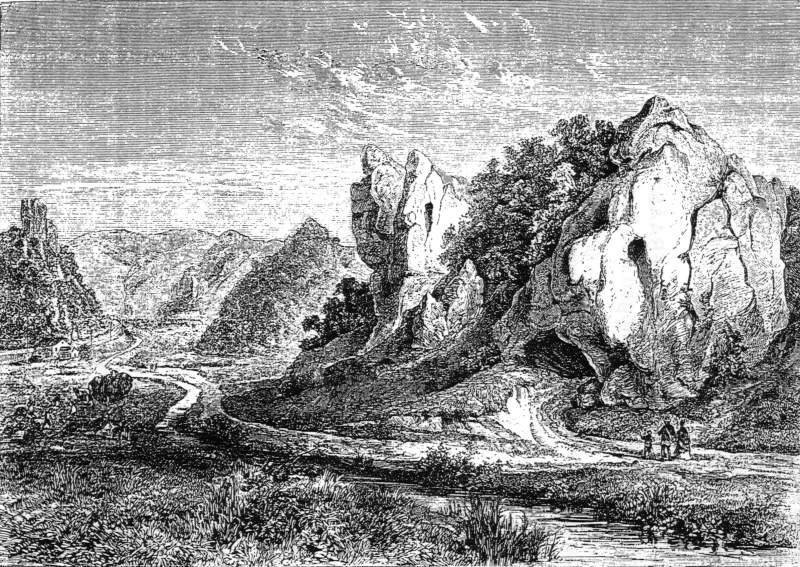
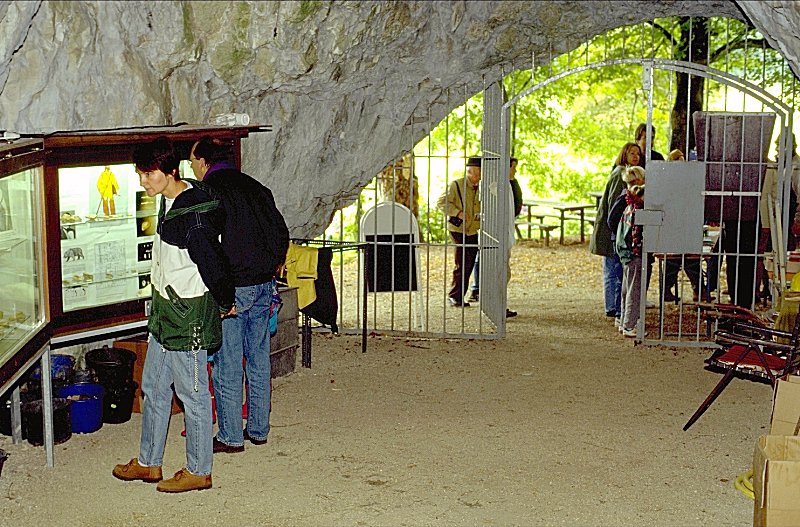
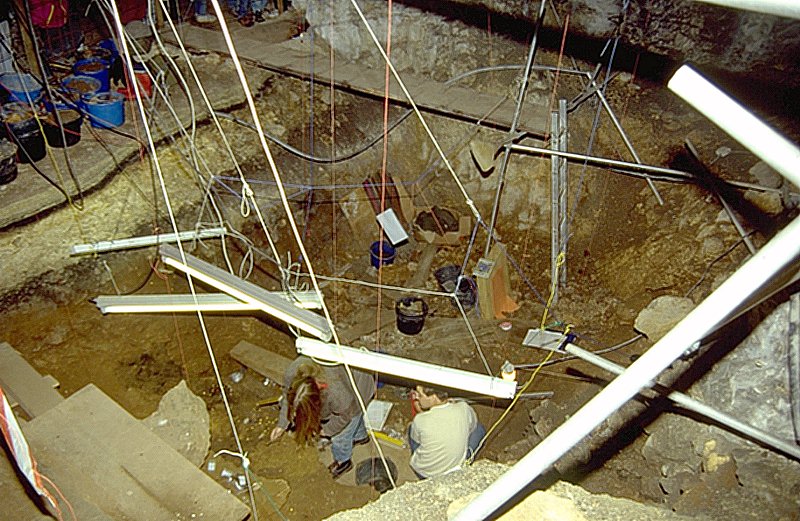
| Location: |
89601 Schelklingen.
From Ulm B28 Blaubeuren-Schelklingen. Turn left at the city limits of Schelklingen. 500 m to car park, 5 minutes walk to the cave. (48.3792375, 9.7540170) |
| Open: |
MAY to JUL Fri 14-17, Sat, Sun 11-17. AUG to 15-SEP Wed-Fri 14-17, Sat, Sun 11-17. 15-SEP to OCT Fri 14-17, Sat, Sun 11-17. Guided Tour: Sat 11:45 and after appointment. [2025] |
| Fee: |
Adults EUR 4.50, Children (6-17) EUR 2, Children (0-5) free, Students EUR 3, Disabled EUR 3. Groups (12+): Adults EUR 3. Guide: EUR 50. [2025] |
| Classification: |
 Karst Cave
Malm (Jurassic limestones) Karst Cave
Malm (Jurassic limestones)
|
| Light: |
 Incandescent Electric Light System Incandescent Electric Light System
|
| Dimension: | L=120 m, GH=23.4 m, 534 m asl, AR=500 m². |
| Guided tours: |
D=1 h, Max=25. V=3.800/a [2005]. |
| Photography: | allowed |
| Accessibility: | entrance area only |
| Bibliography: |
Reiner Blumentritt, Joachim Hahn (1978):
Der Hohlefels bei Schelklingen, Alb-Donau-Kreis, Eine urgeschichtliche Fundstelle im Achtal, Kulturdenkmale in Baden-Württemberg, Kleine Führer, Blatt 46, Hrsg: Landesdenkmalamt Baden-Württemberg, Stuttgart 
E. Wagner (1979): Eiszeitjäger im Blaubeurener Tal, Führer zu archäologischen Denkmälern in Baden-Württemberg, Bd. 6, Theiss, Stuttgart 1979.
Bernhard Mangold, Andreas Pöhler (1966): Der Hohle Fels, Laichinger Höhlenfreund, 1. Jahrgang, 2. Halbjahr 1966, Heft 2
|
| Address: |
Museumsgesellschaft Schelklingen, Verein für Heimatgeschichte e.V., c/o. Rosemarie Schuh, Bahnhofstraße 3, 89601 Schelklingen, Tel. +49-731-384910.
E-mail: Tourist-Information, Marktstraße 15, 89601 Schelklingen, Tel. +49-7394-248-17. E-mail: |
| As far as we know this information was accurate when it was published (see years in brackets), but may have changed since then. Please check rates and details directly with the companies in question if you need more recent info. |
|
History
| 1830 | first find of cave bears’ bones by the potter Karl Friedrich Rixinger who was digging for clay in the cave. |
| 1844 | The cave sediments were used as fertilizer. |
| 1870-71 | Excavation by Prof. Oskar Fraas and J. Hartmann. |
| 1872 | Excursion of the Anthropologischer Vereins (Anthropologic Society) to the cave. Most famous participant was Professor Rudolf Virchow. Cave closed by a door. |
| 1905 | Development of stairs and paths and first of the cave festival, which are held until today. |
| 1936 | Hohler Fels declated a Naturdenkmal (Natural Monument). |
| 1944 | Confiscated by the Luftgaukommando V for purposes of the air force, cave floor partially leveled. |
| 1955 | electric light installed and cave closed with massive iron gate. |
| 1958-60 | Excavation by the local historian G. Matschak and Prof. Gustav Riek. |
| 1966 | Survey and article in the |
| 1977-79 | Excavation by Prof. Joachim Hahn from the Institut für Urgeschichte in Tübingen in cooperation with the Landesdenkmalamt. |
| 1987-96 | Yearly excavation of six weeks by Prof. Joachim Hahn. |
| 1997- | Excavations by Prof. Nicholas J. Conard and Prof. H.-P. Uerpmann from the Institut für Urgeschichte der Universität Tübingen. |
| 2017 | inscribed on UNESCO WHL. |
Description
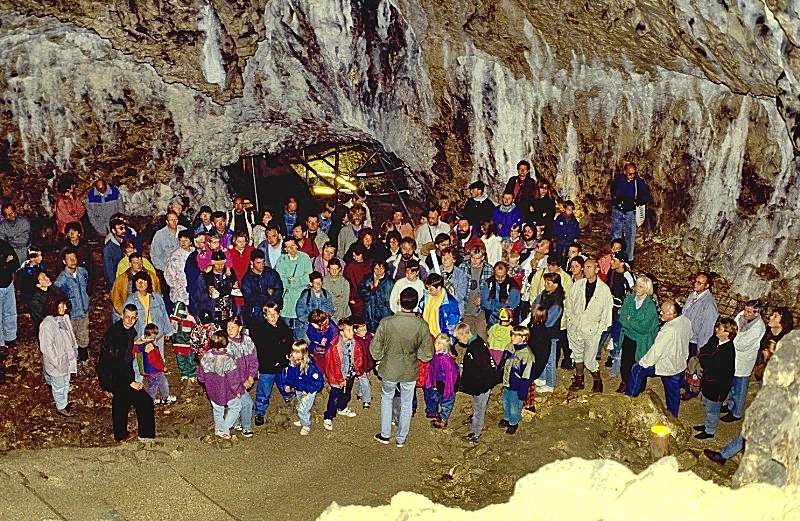

The Hohle Fels is one of the biggest cave chambers of the Swabian Jura. But the cave is only this single big chamber, which is entered through a short passage, which is quite high enough to walk upright. There are two small passages, one to the left and one to right, but both are very short. The cave has no speleothems, but there are some patches of moonmilk on the wall near the entrance. Its main feature are the archaeological remains found here.
The cave was once open to the surface, the shaft can be seen at the far end of the chamber, but it is blocked now. Leaves, wood, and soil from the surface was washed in for a very long time, until it finally filled most of the huge chamber. Those sediments were mixed with guano produced by the bats in the cave. When the locals first explored the cave in the early 19th century, there was only a low passage along todays ceiling, both in the entrance passage and the main chamber. The first attempt to exploit the cave was in search of clay, but was not very successful. The potter Karl Friedrich Rixinger discovered cave bear bones and sold them to a collector from Ulm. Only a few years later the cave sediment was used as a fertilizer, and much of the sediment in the main chamber was removed. To do this, it was necessary to lower the floor in the entrance section, so it was possible to enter the main chamber with carts. The rocks and debris which could not be used as fertilizer were dumped in front of the cave entrance and formed a plateau.
The first scientific attempt to explore the cave was made by the famous Prof. Oscar Fraas, who worked at the Natural History Museum in Stuttgart, did a lot of research in the area and published books and scientific papers. He was the first to understand the archaeological significance of this cave. After two years of excavation he invited a group of famous archaeologists to visit the cave, an excursion which was part of an archaeological conference. There were numerous famous archaeologists of the time, members of the Anthropologischer Verein and also of the Berliner Gesellschaft für Anthropologie, Ethnologie und Urgeschichte. The most famous visitor was internationally renowned Professor Rudolf Virchow. In preparation of the visit the cave was equipped with wooden trails and stairs. But more important for the cave conservation was the fact that the cave was closed by a gate. Still, cave protection was not yet invented, the scientists removed a train car full of findings, and every participant of the excursion was allowed to select an item to take home.
In the following decades there were numerous excavations by local archaeologists, but without extraordinary discoveries. During World War II the cave was used as an air raid shelter, and as a result the entrance area was lowered to allow its use by the locals with cars and farming machinery. The floor was paved with gravel, and got more or less its current state. This development destroyed all upper layers but protected the lower layers from further destruction. And when speleology was revived after the war, the local caving club at Laichingen surveyed the cave for the first time and made a map which is used until today.
An excavation campaign took place from 1977 to 1979 led by Prof. Joachim Hahn from the Institut für Urgeschichte in Tübingen in cooperation with the Landesdenkmalamt Baden-Württemberg. Famous finds were chiseled petrified wood, a harpoon made of an antler and needles from the Magdalenian. From the Gravetien some javelin heads and ivory jewelry items were discovered. Again the archaeological importance of the cave became known. Recurring excavations revealed numerous remains from deeper layers.
After the death of Hahn in 1997 the excavations were continued by Prof. Nicholas Conard.
The highlight during the excavation seasons in 1997-99 was the discovery of a small rock with some paint.
This find was well published, not just in scientific papers but also in the yellow press.
It was called the first proof of cave paintings north of the Alps, and the spectacular publications made the cave Hohler Fels well known.
But not only the way it was published is a little strange, the finding itself is not as unique as the headlines told: already in 1988 Joachim Hahn discovered painted rocks in the nearby
 Geißenklösterle.
It was actually the first sign that Conard was a rather gifted entertainer.
Until today, he was quite successful in discovering new "news-worthy" items, to make sure that there was enough money to continue excavation.
Geißenklösterle.
It was actually the first sign that Conard was a rather gifted entertainer.
Until today, he was quite successful in discovering new "news-worthy" items, to make sure that there was enough money to continue excavation.
The most impressive finds of the cave are:
The
 Venus of Hohler Fels, a female figurine carved from ivory.
Those figurines are rather common and have been found all over Europe.
But the one from Hohler Fels is the oldest so far.
Much less common is the
Bone Flute
which was carved from a bird bone.
Both items are dated some 42.000 years old.
Venus of Hohler Fels, a female figurine carved from ivory.
Those figurines are rather common and have been found all over Europe.
But the one from Hohler Fels is the oldest so far.
Much less common is the
Bone Flute
which was carved from a bird bone.
Both items are dated some 42.000 years old.
Replicas of the discoveries from the Hohler Fels and other nearby caves of the
 Blau valley
are on display in the
Blau valley
are on display in the
 Urgeschichtlichen Museum
in Blaubeuren, in the Heimatmuseum Schelklingen, in the
Museum Ulm,
and in the cave itself.
The Blau valley and the nearby Lone valley have been inscribed on the UNESCO World Heritage List since 2017.
As a result there will be a new Visitor Center at the cave, especially as the cave must be closed during winter due to bat protection law.
However, currently [2020] the construction has not even started.
Urgeschichtlichen Museum
in Blaubeuren, in the Heimatmuseum Schelklingen, in the
Museum Ulm,
and in the cave itself.
The Blau valley and the nearby Lone valley have been inscribed on the UNESCO World Heritage List since 2017.
As a result there will be a new Visitor Center at the cave, especially as the cave must be closed during winter due to bat protection law.
However, currently [2020] the construction has not even started.
In addition to the spectacular archaeological discoveries, there is also a large number of paleontological finds. Since the early mining of the cave sediment as fertilizer, bones were found again and again, Fraas’ railway wagon is legendary. Bones have also been found again and again during recent excavations. In 2002 the age of the cave bear finds from the caves of the Achtal was determined with the C14 method. The results range around 28,000 years, so they can be assigned to the Gravetien. Man and the cave bear lived here "at the same time", and with an extraordinary find it could even be proven that man hunted the cave bear. A vertebra with a broken-off flint tip was found, obviously from a spear or arrow with which the bear had been shot. Another injury on the same vertebra suggests a common hunting, as it was most likely caused by a second hunter. This is the only evidence so far, that humans have hunted cave bears.
And finally some remarks on the German name Hohler Fels. Today mostly the name "Hohle Fels" is used, which is actually wrong. The cave is locally called "the hollow rock" (der hohle Fels), which is simply a description of a Fels (limestone outcrop) which seems to be hollow (the cave). The German form for a proper noun is "Hohler Fels" (Hollow Rock). The general usage of Hohle Fels was introduced by Prof. Conard, the US archaeologist who obviously has problems with German declension himself. Nevertheless, this form is now widely accepted in literature, for obvious reasons, despite the fact that it is grammatically wrong.
- See also
 Subterranean World Heritage List
 Search DuckDuckGo for "Hohler Fels"
 Google Earth Placemark
 OpenStreetMap
 Hohle Fels - Wikipedia (visited: 07-OCT-2011)
 Hohle Fels – Teil des UNESCO Welterbes, official website (visited: 10-MAR-2025)
- Der Hohle Fels (visited: 10-MAR-2025)
- Ancient Flutes (visited: 06-AUG-2022)
- Caves and Ice Age Art in the Swabian Jura, The World Heritage List, UNESCO (visited: 06-AUG-2022)
 Index
Index Topics
 Hierarchical
 Countries
 Maps
Maps