Doline
Sinkhole - Cenote
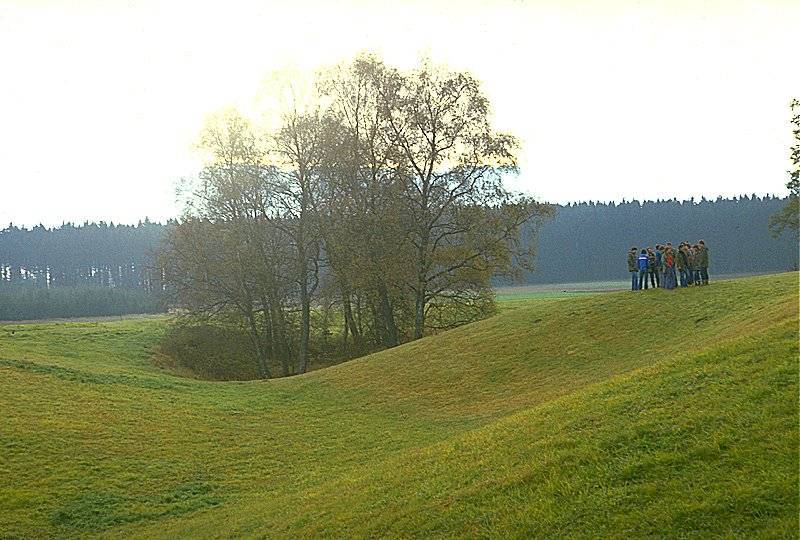
 Schwäbische Alb (Swabian Jura), Germany.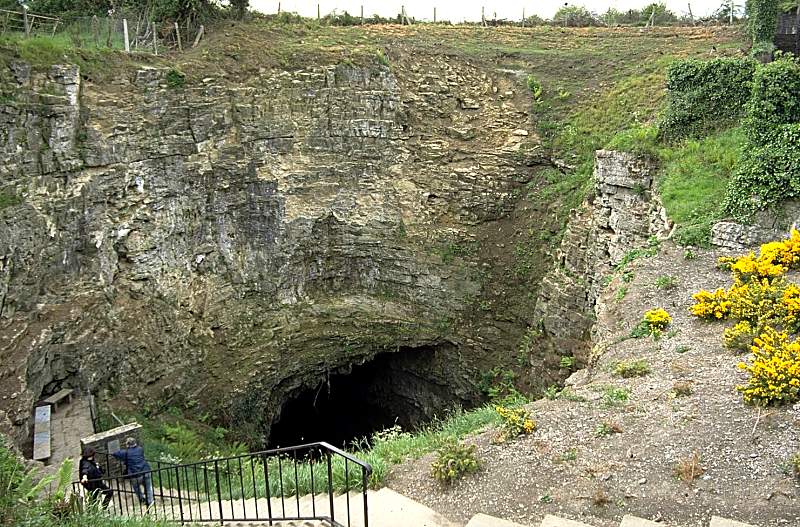
 Dunmore Cave, Ireland. Image by Mathias Duckeck.
A doline, sink or sinkhole is a closed depression draining underground in karst areas. It can be cylindrical, conical, bowl- or dish-shaped. The diameter ranges from a few to many hundreds of meters.
However, the key factor is that it is drainless, in other words, there is no valley through which precipitation could drain away. If a sinkhole is connected to a cave system, the precipitation water disappears into this cave. However, such a hollow form can also become blocked by the weathering residual of the limestone, clay. This creates a lake, which is quite unusual in karst areas with underground drainage. There are normally no standing or flowing waters here.
The name doline comes from dolina, the Slovenian word meaning valley. So this was originally a colloquial Slovenian word which was used by the geologists to describe a geologic feature. Locus typicus (type locale) is unknown, because the term is old, but it is definitely located in Slovenia. Dolina also has a special significance: the clay layer on the ground retains water, is the raw material for the formation of humus and is usually flat. Ideal conditions for using it for agriculture.
There are two different mechanisms for the formation of sinkholes: dissolution sinkholes are caused by the chemical dissolution of rock, and collapse sinkholes are caused by the collapse of a cavity. The dissolution sinkhole is caused by the dissolution of rock on the earth’s surface. It penetrates the subsoil through a fissure in the limestone and dissolves the walls. Due to increasing saturation, the dissolution becomes less pronounced with depth, so that in the sinkhole the rock on the surface is usually almost completely dissolved, while deeper down there are only fissures, which become increasingly narrow. A collapse sinkholes is caused by the collapse of an underlying cavity. In this case the solution happened in the underground, and the doline was form by tectonic movement, and not by solution. However, it is often a hybrid of these two types of formation. Although the two terms sinkhole and sinkhole describe fundamentally different things, it is not possible to distinguish between them based on their appearance.
 Solutional Doline
 Search Duck Duck Go for "Sinkhole"
 Sinkhole (visited: 02-JUL-2019)
 Sinkholes (visited: 16-MAY-2020)
 Index
Index Topics
 Hierarchical
 Countries
 Maps
Maps Search