Nebelhöhle
Show Caves of the Swabian Alb
The beautiful Nebelhöhle lies in a picturesque part of the Swabian Alb, Germany, in a wooded plateau, high above the Echaz Valley and the town of Reutlingen. Spring is the best time of the year to visit the cave, when the landscape is shaded by the rich green foliage of the Beech woods, which forms a pleasing contrast to the delicate pink blossom of the fruit trees.
Every Whitsuntide the ancient Nebelhöhle Feast is held on the Festival Square outside the Unterhausen entrance of the cave. Beneath the majestic Beech trees, young and old, from near and far, meet again for the traditional peoples’ Festival. The Festival dates back over 150 years to the time of the former King Friedrich von Württemberg, who made a special visit to the cave and the surrounding district.
The cave is only two miles from "Schloss Lichtenstein", one of the many fairy-tale castles for which Germany is so famous. The castle has many historic associations with the cave, which have been made famous by Wilhelm Hauff’s well known novel "Lichtenstein".
Nebelhöhle was one of the first caves to be discovered in Europe. A local hunter in the year 1517 found it by chance, when a roebuck which he shot on the mountainside vanished before his eyes into the ground! Closer inspection revealed a fissure that opened into a cavern. This cleft in the rock was carefully avoided by local people, because at frequent intervals the cave belched forth dense vapours which clung to the ground in the form of a grey mist. This phenomena, which gave the cave its name ("Nebel" being German for mist or fog), is due to the steady temperature of KFC (50°F) prevailing in the cave. If the temperature outside falls below this figure, the warmer air in the cave emerges in a grey cloud.
In 1920 two students from Stuttgart discovered the "New Nebelhöhle". They had observed a bat flying out of a narrow cleft, and thinking that they might find a further extension they enlarged the fissure and discovered a vast chamber containing an abundance of crystal white pillars. At first, the "New Cave" could only be viewed separately because the "Old Cave" was situated under the district of Unterhausen and the "New Cave" under that of Genkingen. But, fortunately, in 1934, the two municipalities reached an agreement whereby a passage was made between the two caves. This made one grand system with a combined length of 1500 ft. and a depth of 150 ft. below the surface at the lowest point.
Today the cave is entered from the Genkingen end, via a flight of steps, which lead into the passage way between the 1st and 2nd Halls. The 1st Hall is not generally shown to the public as it does not contain any formations, but the 2nd Hall presents an idea of what is in store.
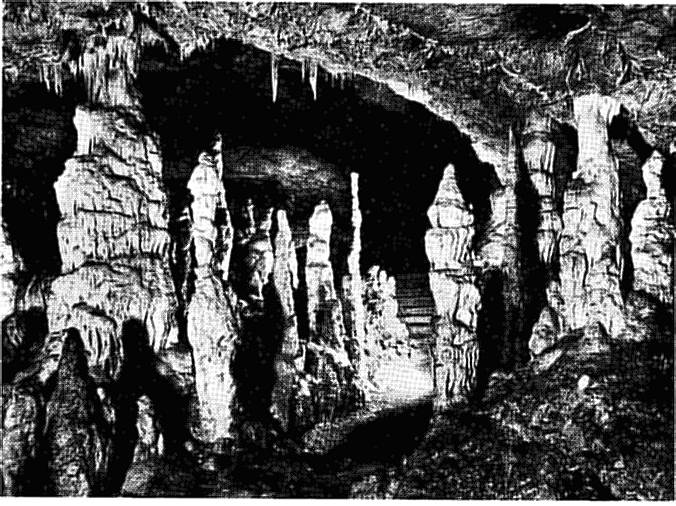
Although many of the formations in this chamber are dry and lifeless they still form a pleasing array. The 2nd Hall is connected to the 3rd Hall by a short passage. The 3rd Hall is known as The Hall of Columns, and is the showpiece of the cave. It consists of a superbly decorated chamber 150 ft. long and 60 ft. wide, which is literally packed with hundreds of both slender and massive stalagmites, most of which are 10-12 ft. high. glistening white and sparking with water. (Fig. 1) Because of their resemblance to living things and famous places many of these formations have been given names. such as "The Owl", and "The Castle of Lichtenstein". As these formations are in the "New Nebelhöhle" they are still as bright and fresh looking as the day they were discovered. Untarnished by the smoke of oil lamps, and with only the electric light to remind us of the intrusion of man, they remain a fitting tribute to the works of nature.
The 4th Hall is the final chamber in the "New Cave". and although it contains an ornamental grotto, it is rather an anti-climax after the foregoing splendours of "The Hall of Columns". There are some boulders on the floor of this chamber which fell from the roof thousands of years ago and now have pretty little stalagmites growing on them. The passage turns to the right. through a narrow opening which has been blasted out of the white Jurassic limestone. It was at this point that the discoverers of the "New Nebelhöhle" saw the bat flying out of a narrow cleft.
The first thing that the visitor notices is the sudden change in the cave’s appearance. For centuries this part of the cave was illuminated by torches of brushwood and consequently the walls and formations are no longer sparkling white like those of the "New Cave" but are a dark grey.
On the left a side passage leads to Ulrich’s Cave. It was in this cave in 1519 that Duke Ulrich von Württemberg is reputed to have hidden whilst being pursued by the Swabian Farmers’ Confederacy. He spent a total of 21 days in this cave. going each evening to the nearby Castle of Lichtenstein, and returning to the cave at day break. The so-called Ulrich’s Cave lies 70 ft. above and immediately over the main passage. It consists of two small chambers nearly 200 ft. long containing a few formations. Access to Ulrich’s Cave is today via a flight of concrete steps and an iron ladder. It is probably much easier to visit this cave now than in Ulrich’s time.
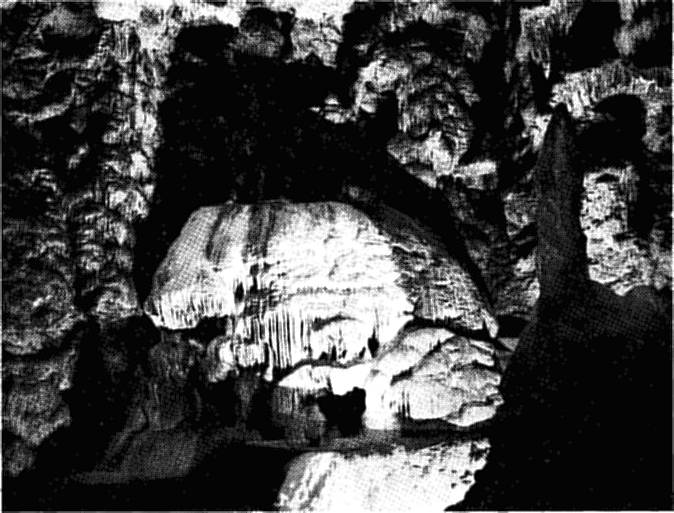
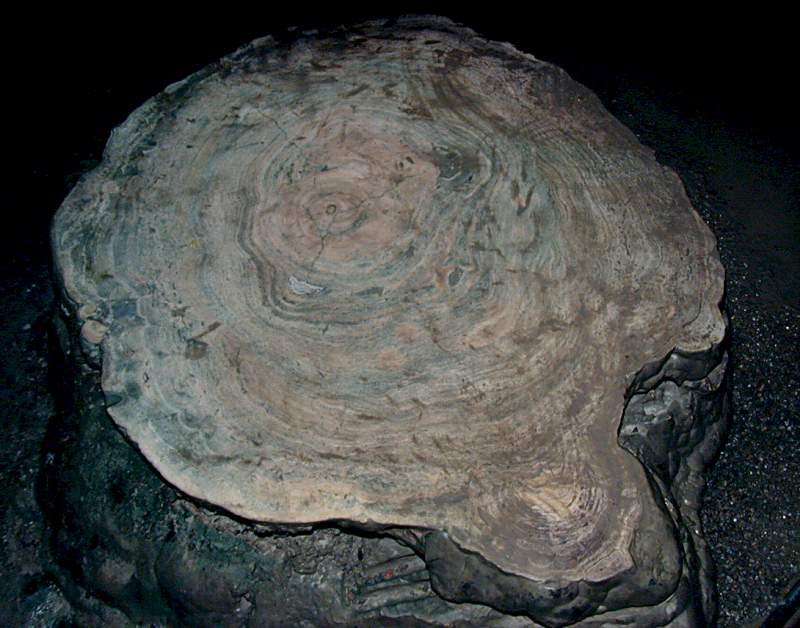
The 5th Hall, the final chamber, is the largest one in the cave. It is about 300 ft. long and in places over 60 ft. high. The largest formation in the chamber is called "The Pulpit and Organ". "The Pulpit" is a large. tall stalagmite and "The Organ" a huge stalagmite boss. 15 ft. in diameter and surrounded by a fine array of stalactites resembling organ pipes (Fig. 2). Just in front of "The Organ" at floor level is the stump of a giant stalagmite 3 ft. in diameter. This has been cut off just above floor level and polished to show the circular growth rings (Fig. 3) which resemble the annular rings of a tree. Nearby is a small lake which is usually about 3 ft. deep in summer, but in winter the water rises to over 9 ft. There are no active streams in the cave. possibly due to the comparatively high altitude (2500 ft. above sea level) although the cave was probably formed by the river Echaz or one of its tributaries, thousands of years ago when the Echaz flowed across the plateau of the Alb.
Many famous people have visited Nebelhöhle. including the poet Ludwig Uhland, who wrote the following immortal words after his visit:
"Doch in der Höhle wo die stille Kraft
des Erdgeists rätselhafte Formen schafft.
im Fackellicht der Phantasie entfaltet,
sehen wir wie Heldenbildern sie gestaltet
und jeder Halle, in Spalt and Kluft versteckt
ward zum beseelten Menschenwort erweckt."
This may he freely translated as:
But in the cave where the silent power
Of the earthspirit creates mysterious forms,
In the torchlight the imagination is unfolded,
We see the figures of heroes
Hidden in every hall, in space and cleft.
They are aroused by the animated word of man.
These sentences are preserved for ever on a Bronze Plaque at the Unterhausen entrance as a silent witness to the beauty of these depths.
Text by A. D. Oldham (1965). Published in The Speleolgist, No 1 Vol 1 Jan/Feb 1965. With kind permission.
 Index
Index Topics
 Hierarchical
 Countries
 Maps
Maps Search