Wonderwerk Cave
Useful Information

| Location: |
Danielskuil, Northern Cape.
Kuruman-Danielskuil road, 45 km from Kuruman, turn off to Wonderwerk Cave is signposted.
Keys and visitors book at the farm house.
(-27.844309, 23.554842) |
| Open: |
All year Mon-Fri 8-16, reservation mandatory. [2023] |
| Fee: |
Adults ZAR 20. [2023] |
| Classification: |
 Karst cave.
Dolomitic limestone, Ghaap Plateau Dolomite Formation. Karst cave.
Dolomitic limestone, Ghaap Plateau Dolomite Formation.
|
| Light: |
 Incandescent Electric Light System Incandescent Electric Light System
|
| Dimension: | L=139 m. |
| Guided tours: | yes |
| Photography: | allowed |
| Accessibility: | yes |
| Bibliography: |
Michael Chazan; Hagai Ron; Ari Matmon; Naomi Porat; Paul Goldberg; Royden Yates; Margaret Avery; Alexandra Sumner; Liora Kolska Horwitz (2008):
Radiometric dating of the Earlier Stone Age sequence in Excavation I at Wonderwerk Cave, South Africa: preliminary results
Journal of Human Evolution, 55(1), 1–11.
DOI
pdf
|
| Address: | Wonderwerk Cave Project, Wonderwerk, R31, Kuruman, 8460, Tel: +27-87-310-4356. |
| As far as we know this information was accurate when it was published (see years in brackets), but may have changed since then. Please check rates and details directly with the companies in question if you need more recent info. |
|
History
| 05-JUL-1844 | first description of the cave by H. Methuen. |
| the first white farmer at Wonderwerk P. Bosman lived in the cave with family and afterwards used it as a cart-house and sheep shelter. | |
| 1940-1944 | commercial exploitation of the site for bat guano by N.J. Bosman. |
| 1940-1948 | archaeological investigations by B.D. Malan. |
| 1974-1977 | excavations by K.W. Butzer. |
| 1979 | excavations by J.F. & A.I. Thackeray. |
| 1978-2002 | excavations by P.B. Beaumont. |
| 1993 | cave and surrounding land ceded to the McGregor Museum by the Bosman and Nieuwoudt families. |
| 1993 | declared a National Monument of South Africa. |
| 1993 | opened to the public. |
| 2000 | new legislation makes the site a Provincial Heritage Site. |
| 2005 | 3D map created by the Zamani Project. |
| 2010 | declared a National Heritage Site. |
Description
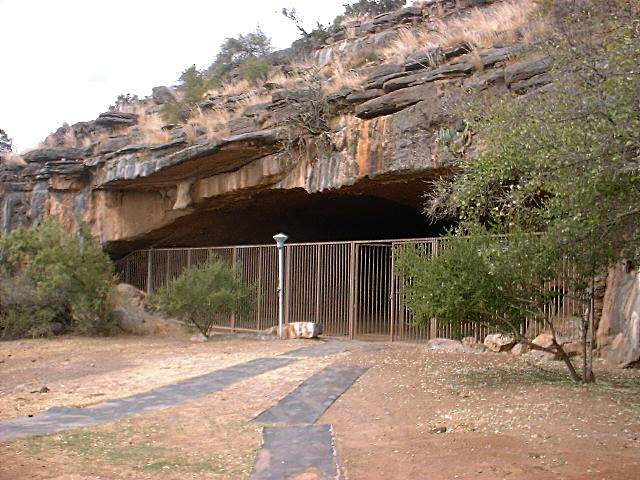
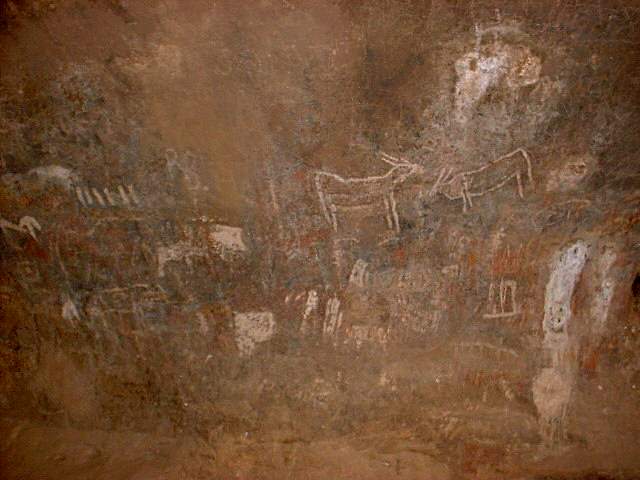
The most interesting feature of Wonderwerk Cave are bushman paintings on its walls, dating back 10,000 years.
The cave was used as shelter by the first white settlers, P. Bosman and his family lived in the cave for some time. Later, the bat guano of the cave was mined and used as fertilizer. This exploitation destroyed vast amounts of sediments and its contents, but also the found artifacts led to the first archaeological excavations. Since 1940 numerous excavations took place in this cave, and they still go on.
The cave was privately owned by the Bosman and Nieuwoudt families until 1993. Because of the importance of the site, it was ceded to the McGregor Museum which managed the scientific exploration. The McGregor Museum established a small museum at the site, which explains the finds and their whereabouts. The museum is part of a cave visit.
Today the cave is protected by an iron grid. It is possible to visit the cave and the excavations, but there are no regular tours. Depending on the activities at the site, the archaeologists or the farmers at the adjacent farm show the cave to visitors.
The cave is a karst cave, but from the speleological point of view it is rather dull. A short passage with a single dripstone formation, a stalagmite two meters high.
The latest discovery in 2012 are ash and burnt bone samples which are interpreted as a sign of the use of fire. The remains are about one Million years old, and so this is the earliest account of man using fire. Similar burnt bones have already been discovered in nearby Swartkrans Cave. The number of discoveries makes it more likely that they are a result of human action and not of natural causes like wildfires. The remains of repeated fires burned 35 m deep inside the cave were discovered, but there were no signs of fire preparation like a hearth or a pit.
- See also
 Search Google for "Wonderwerk Cave"
 Google Earth Placemark
 Wonderwerk Cave - Wikipedia (visited: 18-AUG-2023)
 Wonderwerk Cave, official website (visited: 18-AUG-2023)
- Wonderwerk Cave, McGregorMuseum (visited: 18-AUG-2023)
- Apollo 11 (ca. 25,500–23,500 B.C.) and Wonderwerk (ca. 8000 B.C.) Cave Stones - The Metropolitan Museum of Art (visited: 18-AUG-2023)
 Index
Index Topics
 Hierarchical
 Countries
 Maps
Maps Search