Peak Cavern
by Tony Oldham
The villagers of Castleton have had a right of way to this cavern for over 400 years. Its vast entrance, 60 feet high, 100 feet wide and 340 feet long, once sheltered at least two cottages, and a rope-making industry which virtually died out only about thirty years ago. This industry originally employed up to thirty persons, and it is still possible to see the terraces of the ropeworks and some of the rope made by the last craftsman. Today a local craftsman, Mr. Morrison, is the only person still making the occasional rope in the cave.
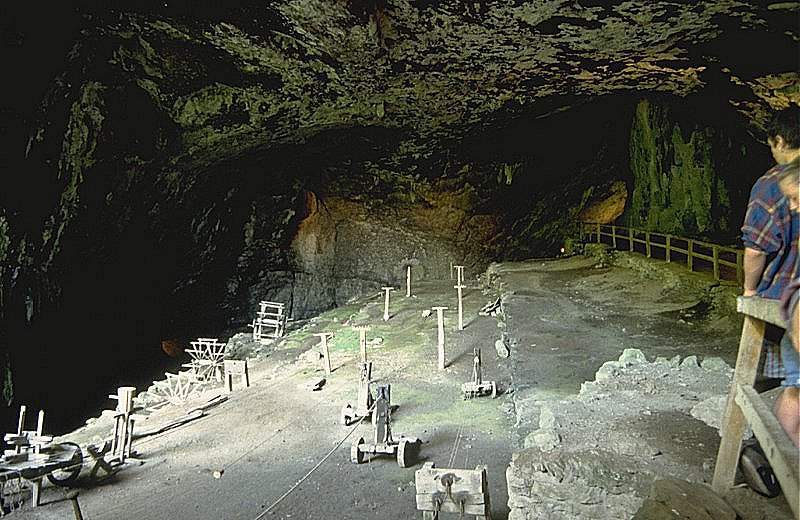
When the rope-making industry was carried on the only light in the cave was from candles, but today it is electrically lit throughout the show section, and the paths have been made up. The path descends to the Inner Styx, the subterranean river, and then reascends to the Great Chamber, 150 feet long and 90 feet high. Soon the sound of dripping water may be clearly heard, and it is necessary for the visitor to pass through a fine spray of water falling from the roof high above, in what is known as Roger Rains House.
When Princess Victoria visited this cave, a choir, ranged in what is known as the Chancel, burst into song. Even today, on special occasions, a choir sings in this part of the cave, also known as the Orchestra Gallery.
Soon the subterranean river is met again and it ftows along beside the path through what is possibly one of the most remarkable sights of any show cave in Great Britain, the five natural arches. Looking back along the electrically lit passage the visitor can gaze through no less than five perfectly shaped arches, each formed by the action of the river swirling through these passages for hundreds of thousands of years.
Note: whilst visiting Peak Cavern, it is interesting to take a look at the water exit from Russett's Well. This is to be found on the left-hand side of the bridge where one turns on to the Peak Cavern path. This is where the water resurges from the subterranean river Styx, which can be seen in the cave. The water takes just over four days to travel from just outside Buxton to Russett's Well, about 10 miles as the crow flies. In times of drought it has proved invaluable to the villagers, for it has never been known to run dry. On the way to Russett's Well the water passes through Speedwell Cavern (ibid) and in fact cavers have now made the connection between Speedwell Cavern and Peak Cavern.
Text from: Tony and Anne Oldham (1972): Discovering Caves - A guide to the Show Caves of Britain. With kind permission by Tony Oldham.
 Index
Index Topics
 Hierarchical
 Countries
 Maps
Maps Search