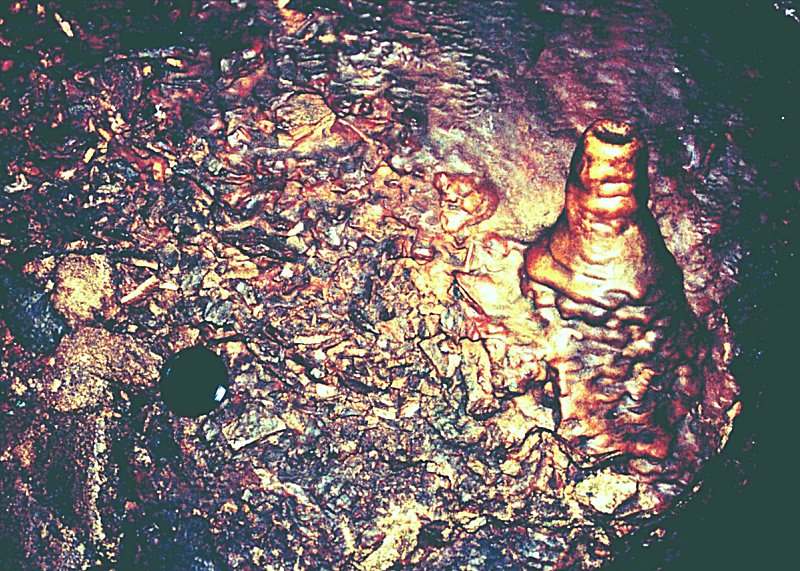
Kents Cavern
Useful Information


| Location: | In the heart of Torquay, from the harbour or from Babbacombe Beach follow Babbacombe road, then Ilsham Road to the cavern. Easily reached by coach/bus, signposted. |
| Open: |
NOV to MAR daily 10-16:30, tours at 11, 12:30, 14, 15:30. APR to JUN daily 9:30-17, first tour 10, last tour 16. JUL to AUG daily 9:30-16:30, first tour 10, last tour 16:30. SEP to OCT daily 9:30-17, first tour 10, last tour 16. Evening Ghost Tour: JUL to AUG Wed, Thu, Fri 18:30, 19:00, 19:30, 21:00. Closed 25-DEC. Discounts for online booking. [2012] |
| Fee: |
Adults GBP 8.95, Children (4-15) GBP 7.95, Seniors GBP 7.95, Students GBP 7.95, Family ticket (2+2) GBP 31. Evening Ghost Tour: Per Person GBP 8.50. Booking required. Parking: GBP 2. [2012] |
| Classification: |
 Karst cave
prehistoric remains. Karst cave
prehistoric remains.
|
| Light: |
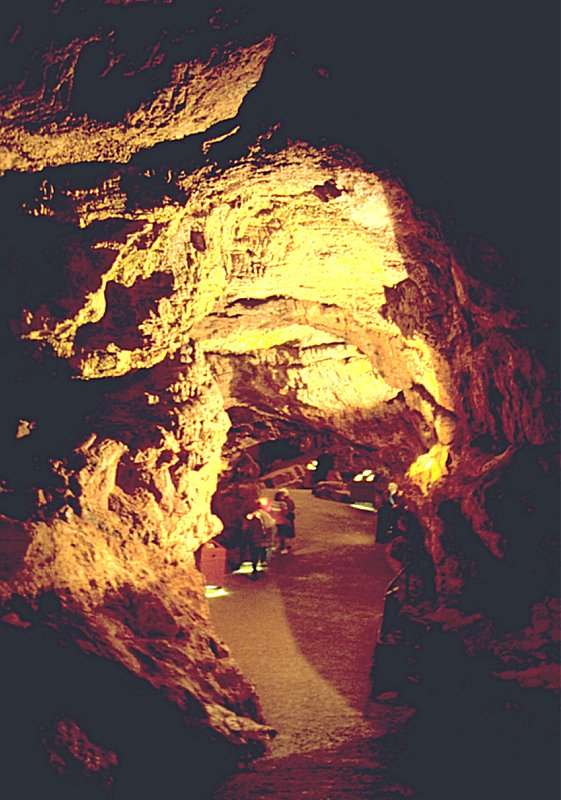
 Incandescent Electric Light System Incandescent Electric Light System
|
| Dimension: | T=14 °C |
| Guided tours: | D=45 min. V=115,000/a [2000] |
| Photography: | Photography allowed, video not allowed for safety reasons. |
| Accessibility: | Suitable for people with a mobility problem and for the partially sighted. Access for wheelchair users is restricted to the first chamber. |
| Bibliography: |
Clive Pemberton (1950):
The Origin And Story Of Kents Cavern,
28pp, SB. With a descriptive tour of the caves by Clive Pemberton 1950, a survey by P M B Lake NP and a Time Chart by J B Sparks. 14 B&W photos, 4 colour photos from paintings by Herbert Truman Arwa, 4 line illus by Ernest Petts. White card cover with blueish photo of Long Arcade. various (2003): Kents Cavern Torquay, 385 million years in the making, 100 years of welcoming visitors, Souvenir guide book, Centenary Edition 2003, 36 pp, SB. Lavishly illustrated, more than one colour photo a page. Introduction by Nick Powe, the Managing Director, other chapters by various authors. Glossy, informative, one of the better show cave guides. Clive Pemberton (1964): Kents Cavern, Home of prehistoric man and animals. The Origin, Story and Descriptive Tour of the Caves. Re-adapted 1972 with a survey by P M B Lake 1934 and a Time Chart by J B Sparks. 32 pp, 14 B&W photos, 4 colour photos from paintings by Herbert Truman Arwa, 4 line illus by Earnest Petts. White card cover with a photo of the Greta Chamber. |
| Address: | Kents Cavern, 91 Ilsham Road, Wellswood, Torquay, Devon TQ1 2JF, Tel: +44-1803-215136, Fax: +44-1803-211034. |
| As far as we know this information was accurate when it was published (see years in brackets), but may have changed since then. Please check rates and details directly with the companies in question if you need more recent info. |
|
History
| 1826 | first excavations took place. |
| 1920's | new excavations. |
| 1952 | designated an Ancient Monument. |
| 2003 | Drinks license granted for underground. The first in the UK. Cavers turning up for a quick drink will be disappointed. It is pre-booked parties only.. |
| NOV-2011 | 41,000 year old human jawbone dated. |
Description

Kents Cavern is one of the most important archaeological sites in Britain. A multitude of remains of mankind, animals, and nature have become trapped and preserved over the last 500,000 years. Until now over 70,000 Palaeolithic remains have been unearthed.
Kents Cavern has some of the oldest human remains in northern Europe. The oldest findings are five flint hand axes dated to be 450,000 years old. They were made by Homo erectus, the Heidelberg man. Much younger are Neanderthal flint tools, numerous have been found in the cave. They are from the middle and upper Palaeolithic and between 120,000 and 10,000 years old. A jaw bone with teeth from Homo sapiens is dated 41,000 years old. This dating was made in NOV 2011 and was in the media, as it made this the oldest fragment of modern human bone ever discovered in Northwestern Europe. There are further remains from the Mesolithic and Neolithic.
As interesting and even more numerous are the findings of animals in the cave. Most famous are the cave bear (Ursus spelaeus) remains from about 50,000 to 20,000 years ago. The oldest bear bones from the cave are half a million years old and belong to its ancestor, the Ursus deningeri. Other bones in the cave are from cave lion (Panthera leo), sabre-toothed cats (Homotherium ladidens), mammoth (Mammuthus primigenius), cave hyaena (Crocuta crocuta), wolf (Canis lupus), red fox (Vulpes vulpes), and woolly rhino (Coelodonta antiquitatis).
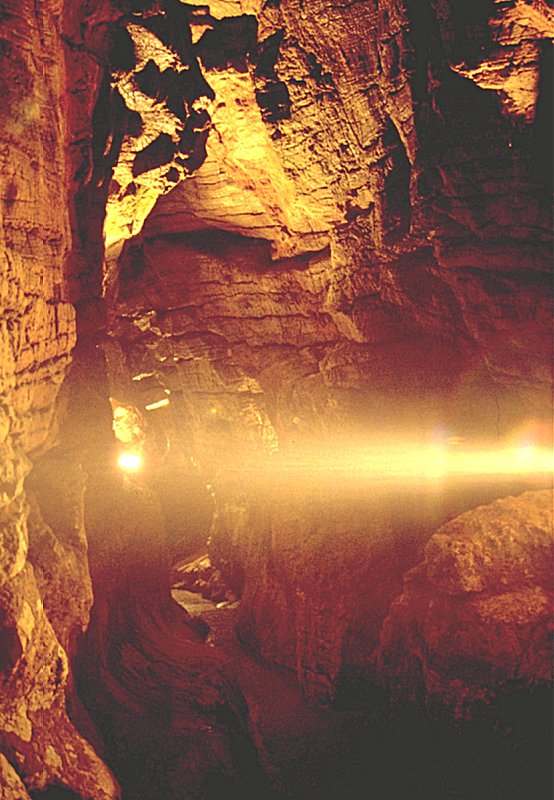
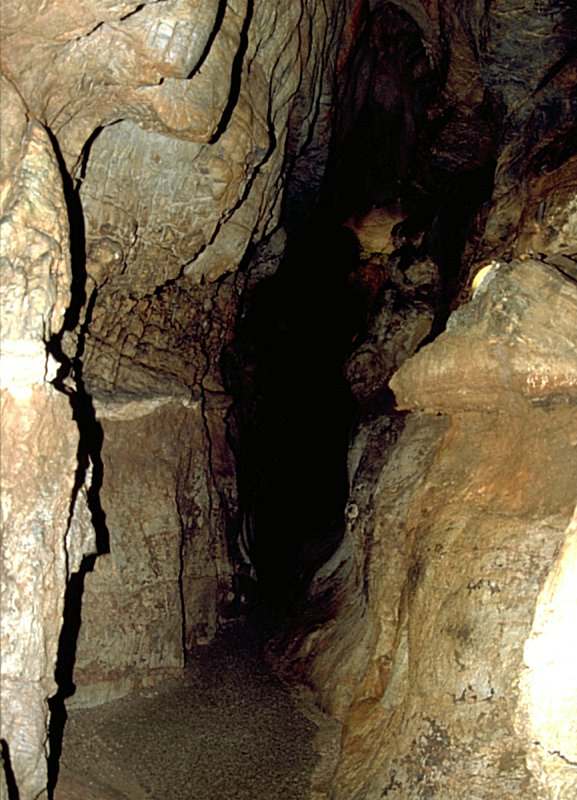
The cave has only one level with passages in two main directions. This labyrinth of interconnected passages was formed along parallel cracks in the rock.
A very interesting feature of the cave is the cave zoo in the last chamber.
It contains only
 troglobites, animals which live in caves.
This are primarily insects and amphibians.
troglobites, animals which live in caves.
This are primarily insects and amphibians.
In summer 1825 a group of 12 explorers entered the cave through the narrow and low entrance, only 1.50 m high. Some members of the coast guard were lead by a man who was determined to discover an ancient Roman temple. They tried to break through the calcified floor with their tools.
The group included Father John MacEnery, a young Roman Catholic priest with an interest in fossils. He entered the cave at the end of the group and stayed away from the workers. He investigated areas of the cave where the ground had already been disturbed. In the light of his candle he discovered fossils in the reddish brown cave sediments. He kept silent about his find, as he guessed the members of his party would take fossils as souvenirs, thus destroying the find.
Between 1825 and 1829 Father MacEnery unearthed the bones of elephants, rhinoceroses, sabre-tooth tigers, cave lions, bears and hyenas. Now science was learning for the first time, that animals, which are known form subtropic or tropic areas were living in the area of Europe. The bones were called antediluvian remains, which means the bones of the animals which lived before and died during the Deluge. Only four years earlier William Buckland, professor of geology at Oxford, had discovered similar fauna in a cave in Yorkshire. He published it in a book called Reliquiae Diluvianae (Relics of the Flood). In this book he stated that there were numerous floods and the last and biggest one was the one described by the bible. He also stated, that humans and antediluvian creatures had not co-existed.
But Father MacEnery found flint tools intermingled with fossil bones, which meant that humans lived at the same time with all those strange animals and in this different climate. He wrote this to Buckland, who reacted rather annoyed and insisted that the flints had been introduced by later human inhabitants of the caves. He was actually unwilling to see his fine theory destroyed. Father MacEnery tried to publish his work, he wrote a manuscript and had plates made by the famous natural history illustrator Georg Scharf. But he was not able to explain his findings without contradicting the theories of Buckland. As a result he never published his work and died in 1841 in his forties.
His work was finally published in 1859 under the title Cavern Researches, in the same year Darwin's On the Origin of Species was published.
As a result Kents Cavern and nearby
 Philp's Cavern
(aka Windmill Hill Cave aka Brixham Cave) were again excavated.
Kents Cavern is today regarded one of the most significant archaeological and palaeontological sites in Britain.
Philp's Cavern
(aka Windmill Hill Cave aka Brixham Cave) were again excavated.
Kents Cavern is today regarded one of the most significant archaeological and palaeontological sites in Britain.
|
| Kents Cavern Gallery |
- See also
 Kents Cavern Description,
text from: Tony and Anne Oldham (1972):
Discovering Caves - A guide to the Show Caves of Britain.
Kents Cavern Description,
text from: Tony and Anne Oldham (1972):
Discovering Caves - A guide to the Show Caves of Britain. Member of the International Show Caves Association (ISCA)
 Search Google for "Kents Cavern"
 Google Earth Placemark
 Kents Cavern, official website.
- Kents Cavern
- Devon Biodiversity Action Plan: CAVES, KARST and MINES
- Kents Cavern: inside the cave of stone-age secrets - Telegraph (visited: 22-DEC-2011)
 Index
Index Topics
 Hierarchical
 Countries
 Maps
Maps Search