Speleokinetics
Speleokinetics is the theory of caves moving and changing their dimension in certain situations. In contrary to the common theories caves tend to move rather fast. This phenomenon is especially applicable to cave entrances, which move around all the time. The speed is weather depending. The most common rules of Speleokinetics are:
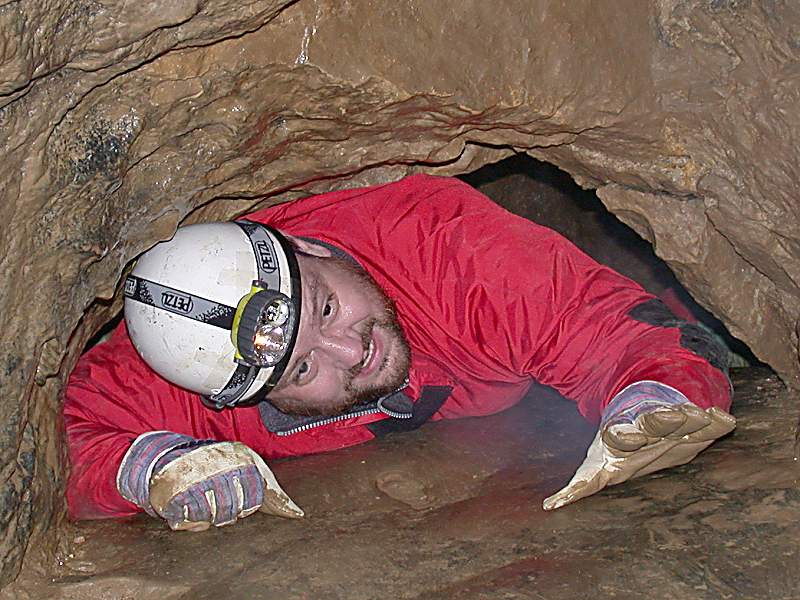
- Lemma 1: cave entrances move around the further from the road.
This rule is applicable all the time, but during bad weather it is overlied by Lemma 2. - Lemma 2: the location and speed of cave entrances depends on the weather.
During rain the entrance moves further away to make sure the caver is as wet and cold as possible when he reaches the entrance.
During mist the entrance moves around, always out of sight, just to be found accidentially when the caver is frustrated on his way back. - Lemma 3: tight sections within caves grow tighter with the passing of time.
Every caver (including me) has a lot of stories about crawls which became much smaller during ten or twenty years, so the caver does not fit in any more. - Lemma 4: crawls always have a fancy puddle halfway which is filled with dripping water.
Just to please us. - Lemma 5a: pitches tend to grow when you carry carefully selected rope of the right length.
Although the rope has the right length to match the length given in the rigging guide, having belayed the rope at the top of the pitch, it no longer seems to reach the bottom. However, there are other theories explaining this observation. Most important is a related lemma of Ropekinetics, which is a sub-science of Speleokinetics: - Lemma 5b: ropes with marked lengths often shrink as one approaches a pitch.
Unfortunately it is both impossible and useless to determine which lemma applies, 5a or 5b. Useless because the rope is still too short, and impossible because of the next lemma. - Lemma 6: (Speleokinetic Uncertainty Relation) if there are more than one speleokinetic lemmas explaining a certain fact, the effort to determine the responsible one will change the result.
And yes, it is similar to the Heisenberg Uncertainty Relation, hence the name. - Lemma 7: resistance against Speleokinetics is futile.
This is a result of the combination of lemma 6 with a general lemma of Murphys' Law: if there are multiple possibilities and you have to decide, you will take the wrong one. - Lemma 8a: fellow cavers disappear in direct proportion to the number of tackle bags that need to be carried.
As you might have mentioned, this rule does not describe the geometry of a cave, but of caving. - Lemma 8b: the number of cavers in a party increases magically with the chance to find pristine passages.
The reversion of 8a, obviously. - Lemma 9: reserve light works well until needed.
Conclusion: cavers should not attach great importance to life long guarantee on reserve light. - Lemma 10a: water in puddles is always deeper than you think.
You will recognize it after you made your first step. - Lemma 10b: water in puddles is always deeper than the shaft of your gum boots.
This is the most common result of lemma 10a. But there are others. - Lemma 10c: if you believe the water to be deep, it isn't.
And your gum boot has a hole.
- See also
 Search Google for "speleo kinetics"

 Index
Index Topics
 Hierarchical
 Countries
 Maps
Maps Search