Show Caves of the Swabian Alb, Germany
Bärenhöhle
by Tony Oldham
Bärenhöhle is situated near the village of Erpfingen, about 10 miles south of Reutlingen. For a time the cave was known as "Karlshöhle", until the discovery of a new series in 1949, named Bärenhöhle. For some years afterwards the cave was known as Bären-Karlshöhle, but today it is called by one name, Bärenhöhle (Bears Cave), the Home of the Cave Bear.
"Karlshöhle" (formerly known as "Erpfinger Höhle") was discovered quite by chance on 30th May, 1834, by a local schoolteacher, called Fauth. Fauth was gathering herbs and digging for Valerian root when he was startled to see some stones roll into a gap between two large boulders. To his surprise he heard them land in the depths and to verify this he threw several more stones down. As he bent forward his tobacco box fell from his pocket into a small crevice at the edge of the drop. Gently, he removed a small stone but in doing so he dislodged the box so that it fell into the cave. Peering into the depths his surprise was even greater when he saw a human skeleton!
The following day he returned to the hole with several friends and the necessary ropes. He was soon lowered into the cave and his friends quickly joined him. In the glimmering light of their candles the more they saw, the greater was their amazement. The floor of the chamber was covered with human and animal skeletons, while their passage was further hindered by multitudes of stalagmite formations. Remembering the cause of their errand they searched very carefully for Fauth's tobacco box but could not find it anywhere. When they left the cave they each took with them bones and stalagmites as proof of their discovery.
After the first exploration the news of their discovery spread. People from the surrounding villages came to visit the cave and nearly all the bones and formations were either destroyed or carried away. A report was made to the Royal Administration and the cave was placed under their supervision.
In order to provide better access to the cave a hole was dug at the western end. This proved quite practical as the cave at this point consisted of clay and boulders of Jurassic Limestone, indicating that there had been an entrance here at earlier times, although it was probably blocked with glacial debris after the last ice age. The short excavated passage still leads to the First Chamber. This is about 20ft. high and 50ft. wide. In one corner daylight shines in through a hole in the roof called "Fauthsloch" after the discoverer of the cave as it was through this opening that Fauth and his friends first descended in order to explore the cave. Beneath "Fauthsloch" there used to be a large mound of debris about 15ft. high containing 50 skeletons of the Plague, together with the bones of horse, cow, pig, sheep, dog, polecat and hare. These remains dated from 700 AD back to the Hallstatt period of the Iron Age. Evidence in the form of flints has also been found in this chamber proving that early man used this cave at the time of the Reindeer Hunters.
The Second Chamber continues on from the first without any change in passage cross-section. The two chambers are very similar although the second is not quite as long and only contains a few rather grubby formations.
On the right is the site of an ancient fireplace just in front of a beautiful cascade. Here a large amount of wood-charcoal was found together with the bones of deer and pig, further evidence that early man lived in this cave.
The Third Chamber presents a complete contrast from the two proceeding chambers. The first thing which one notices are the large boulders through which the pathway winds. Many of these boulders are over 12ft. long and weigh many tons. On one boulder a stalagmite is growing. It is already 3ft. high showing that the boulder fell from the roof a long time ago. The footpath dips down into a hollow and the visitor arrives in The Forth Chamber. The formations are rather dry and dead and one is inclined to hurry on to The Fifth Chamber where the highlight is the large stalagmite called "The Peak" which has a slender stalactite above it. The surrounding walls are covered with calcite drapery.
At this point it would not be out of place to mention the cave lighting, most of which is fluorescent, giving a daylight effect. The lights are cunningly concealed behind boulder piles thereby harmonising with the natural beauties of the cave.
The Sixth Chamber is the most beautiful in the old cave, being 45ft. high and 60ft. wide. This chamber is also called "The Old Cavebear Cavern" for it was here that most of the Bear remains, skulls, bones, etc. were found. After passing the deepest point in the cave one climbs a flight of steps which lead to The Seventh Chamber. A rear view of the cave from this vantage point is a most rewarding sight with arrays of formations receding into the distance. The Seventh Chamber which marks the end of the Old Cave does not contain any formations of note.
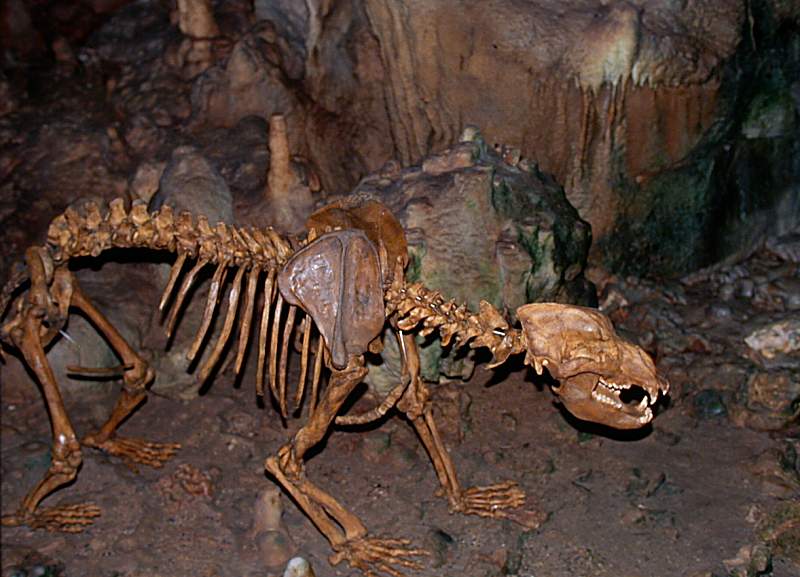
The new cave was found in 1949 by a former cave guide, Karl Benz, who now works in a local factory. The present-day visitor enters the new series by a short flight of steps that have been blasted through a large stalagmite flow. There is a bend in the narrow passage and suddenly one stands on a balcony overlooking a vast chamber covered with the most magnificent white stalagmite pillars. This is the new Bärenhöhle, the highlight of the cave. These stalagmites just have to be seen to be believed. They are not just smooth cylinders of calcite but tier upon tier of flowing draperies, sparkling and twinkling in the cave lights. As one ascends the steps into the Great Hall one is overwhelmed by the size of the Chamber, 30ft. high, 100ft. wide and disappearing into the distance 180ft. away. Everywhere in this Chamber one can see the bones of now extinct animals. The lion, bear, etc. bones that have been covered with stalactite nearly half an inch thick. In one corner a bear's skeleton stands, re-assembled and erected (Fig. 1). Mosses and lichens grow beneath the lights to form a pretty array, although they are regarded as pests as they often grow on formations.
The predominant features of this chamber are the pure, snow-white formations, in a diversity of sizes and arrays. The tall slender pillars are the main attraction but not to be overlooked are the sheets of flowstone on the cave walls and the enormous stalagmite bosses 3ft. in diameter and 10ft. high with folded draperies around the circumference. "Near the end of the Chamber, just before the exit is a 60ft. high aven in the roof which nearly reaches to the surface. From the base of this aven hang many draperies locally known as "Ribs". These caves have been the winter haunts of bats from time immemorial. Long before Bärenhöhle was discovered multitudes of bats lived and died in these caverns, leaving their remains for future archaeologists to find. Today the conditions are no longer as favorable towards bats as in times gone by. The main reason for this being the second exit which causes a change in the cave's climate by permitting the cold and warm air to circulate through the chambers, affecting both the temperature and humidity.
The continuous stream of visitors and the lighting is also unfavorable, so that the majority of bats have deserted the cave for other haunts. During the many years of observation it was found that the number of bats in the cave is gradually decreasing but with bats in summer quarters this is not the case. This, therefore suggests that the disturbance has caused the bats to frequent other caves and hiding places.
Reprinted from The Speleologist, Vol 1, No 2, March 1965. With kind permission.
 Index
Index Topics
 Hierarchical
 Countries
 Maps
Maps Search