Punkevní jeskyně
Punkva River Cave - Punkwahöhlen
Useful Information
| Location: |
North of Brno.
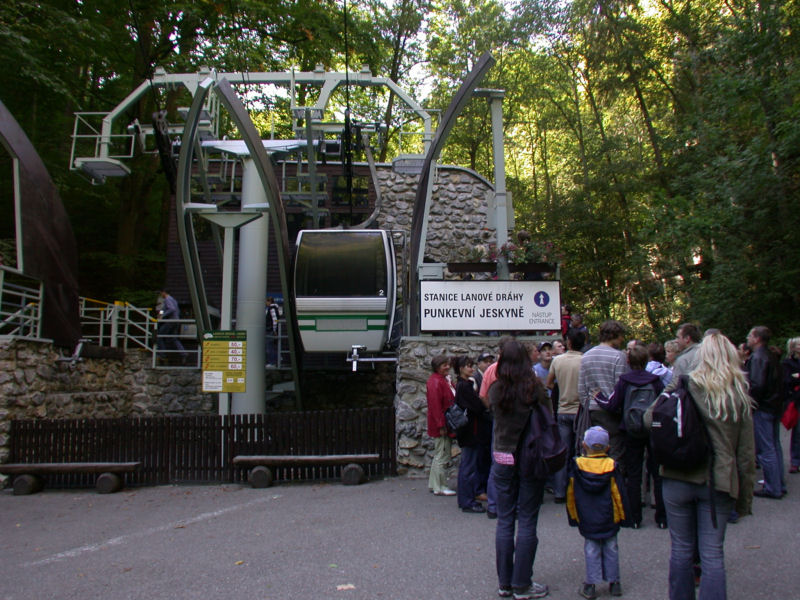
Near the Skalni mlyn Hotel in the Pusty zleb (deserted valley). (49.3711279, 16.7261975) |
| Open: |
JAN to MAR Tue-Sun 8:40-14. APR to SEP Mon 10-16, Tue-Sun 8:20-16. OCT to DEC Tue-Sun 8:40-14. Closed 01-JAN. [2022] |
| Fee: |
Adults CZK 280, Children (3-15) CZK 150, Children (0-2) free, Students (-26) CZK 230, Disabled CZK 150, Seniors (65+) CZK 230. Photography Permit CZK 30, Video Permit CZK 100. [2022] |
| Classification: |
 Karst cave
Devonian limestone. Karst cave
Devonian limestone.
|
| Light: |
 Incandescent Electric Light System Incandescent Electric Light System
|
| Dimension: | L=32,500 m, T=8,9 °C. |
| Guided tours: | L=1,250 m (800 m by foot, 450 m by boat), D=60 min, St=198, MinAge=3. V=195,000/a [2000] |
| Photography: | allowed, no flash, selfie stick or tripod |
| Accessibility: | no |
| Bibliography: | |
| Address: |
Punkevní jeskyně, Hynek Pavelka, 67801 Blansko, Tel. +420-516-418602.
E-mail: Skalní Mlýn - Informační centrum, 67825 Blansko, Tel: +420-516-413575, Tel: +420-516-410024, Fax: +420-506-415379. E-mail: |
| As far as we know this information was accurate when it was published (see years in brackets), but may have changed since then. Please check rates and details directly with the companies in question if you need more recent info. |
|
History
| 1909 | discovered by a group of explorers headed by Prof Karel Absolon. |
| 1914 | cave opened to the public as far as the Macocha Abyss. |
| 1921 | underground River Punkva exploration started. |
| 1933 | lower level with boat ride opened to the public. |
| 1996 | the AOPK CR spent 13,9 million CZK on reconstruction of the visitor trail. |
| 18-MAR-2004 | named as a Ramsar site for the List of Wetlands of International Importance. |
Description

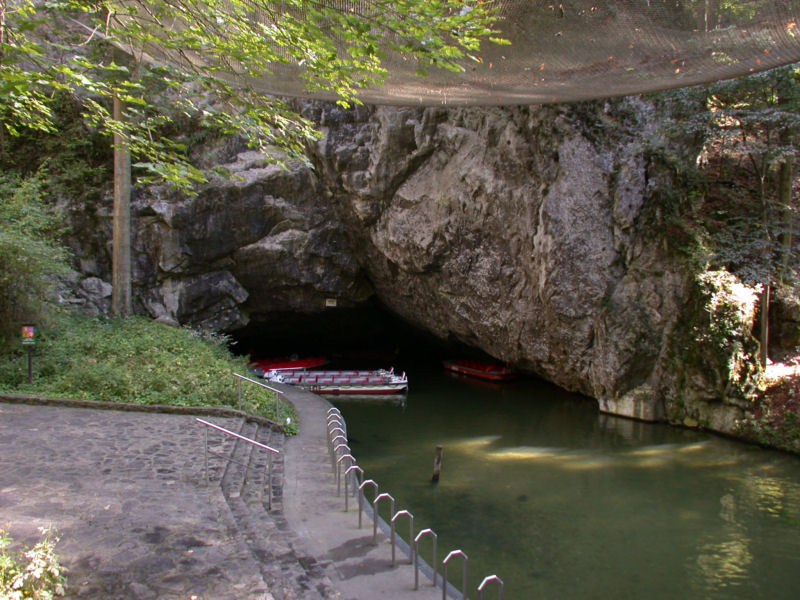
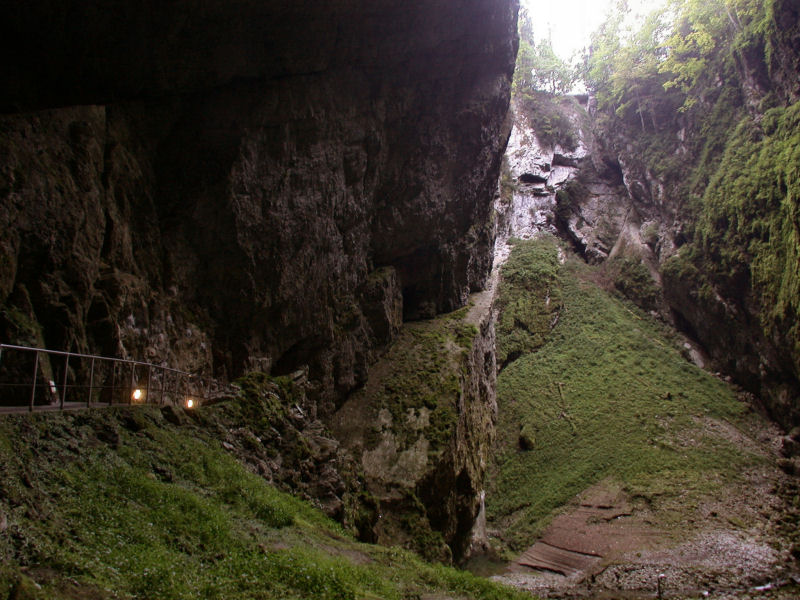
There are two entrances to these caves. They were formed by the subterranean River Punkva which today resurges at the lower entrance. Both entrances lead to the Macocha Abyss, a 138 m deep pothole, open to daylight.
The tour begins at the Upper Entrance. The first chamber is called The Front Dome. It was here on September 26th 1909 that Prof Karel Absolon discovered the profusely decorated upper galleries. This was followed by more discoveries and by 1914 the cave was opened to the public as far as the Macocha Abyss.
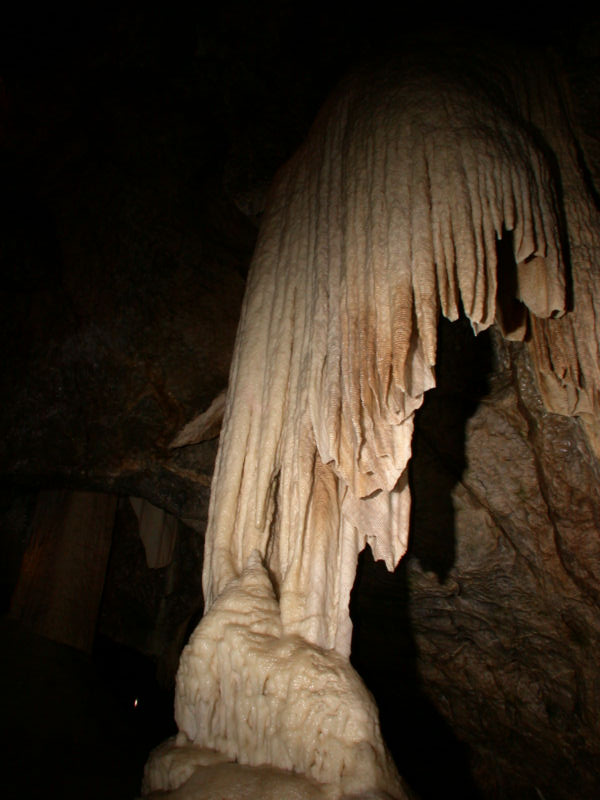
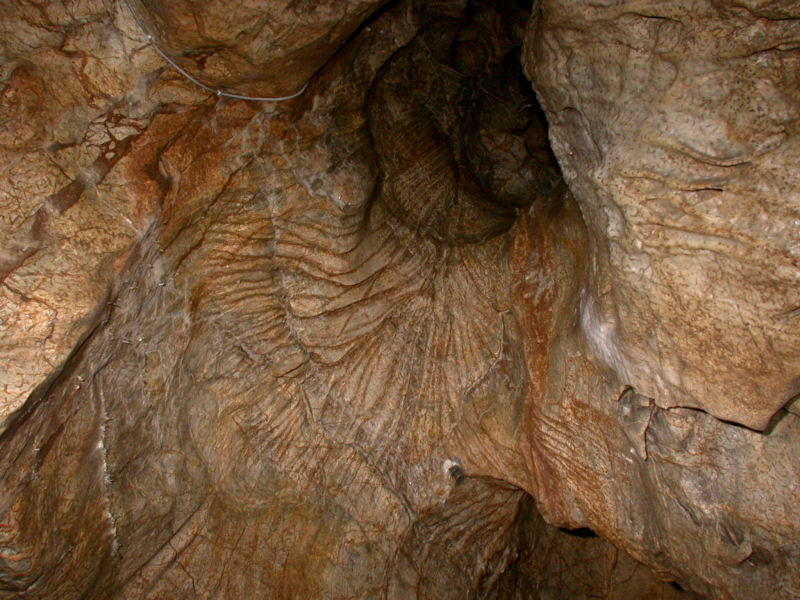
The Mirror Lake. Just after the Front Dome the passage descends to the water table. At one time this was the limit of exploration, but the sump has been partially drained and the pathway allows the tourist to cross this chamber dry shod. Here there is a large formation called The Umbrella. This type of speleothem is called a shield and is formed by water oozing out of a crack in the rock wall.
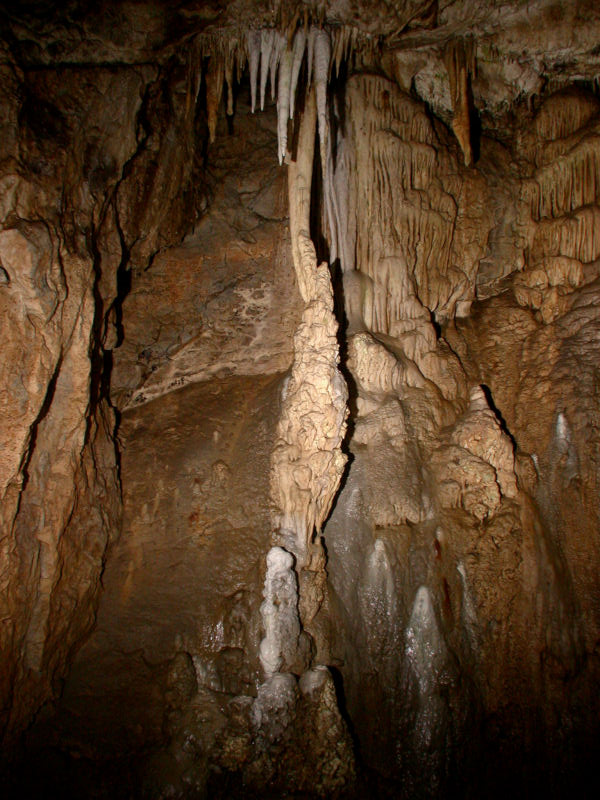
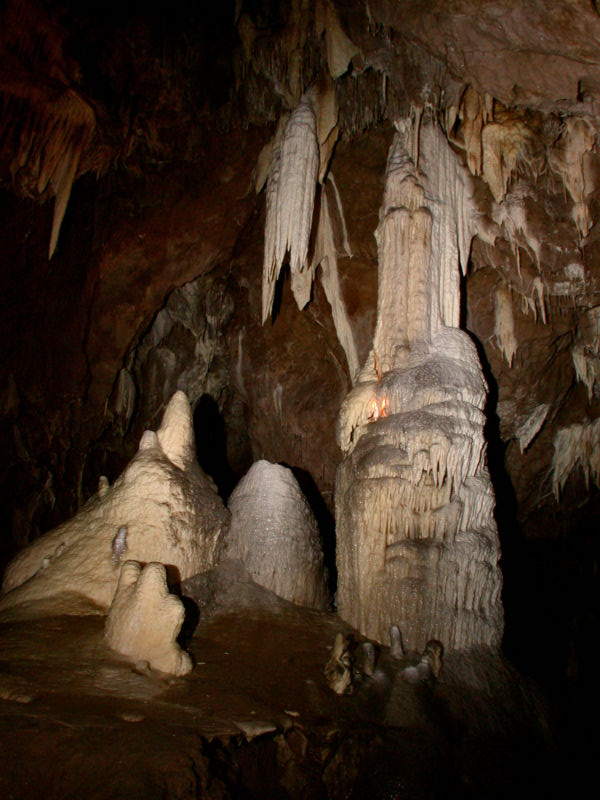
The Reichenbach Dome. Going through the passage which used to be a sump, and climbing a steep slope, the passage levels out into the upper level again. The floor is littered with boulders and the chamber is called the Reichenbach Dome or Dome of Destruction. Two charts with the years marked on them show the water level in times of flood. A sobering thought when one considers that the Mirror Lake is many meters below this point. The route passes through The Stalagmite Gallery where the numerous speleothems have been given names like the Sitting Hare, the Snow covered Fir, the Camel, and the Rococo Puppet etc.
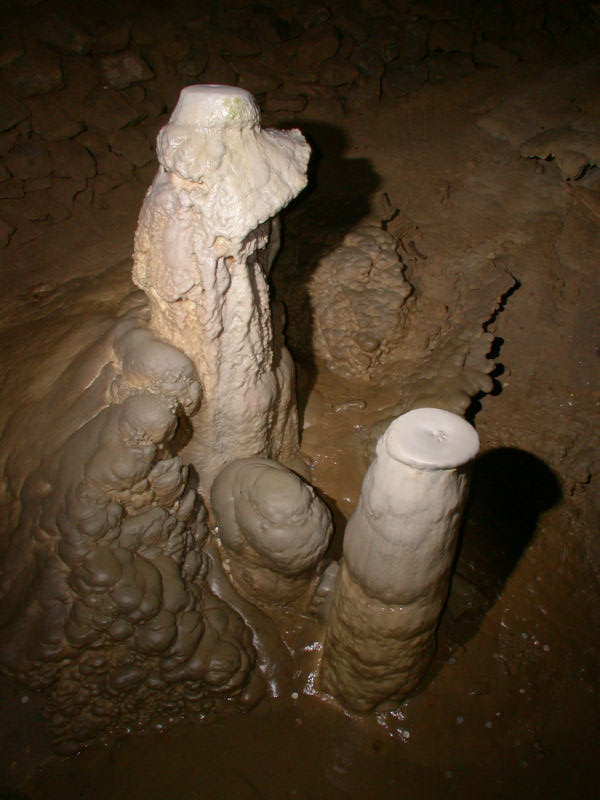
The Hinder Dome. Leaving the upper levels one descends into the Hinder Dome or Dom of Quiet. This is at the same level as The Front Dome. The long slope is covered with a group of stalagmites called The Turkish Cemetery. The pile-like stalagmite is called the Snezka or the Snow Pile and demonstrates a strange and unpleasant aspect of show caves, Lamp Flora. Visitors bring spores and seeds on their clothing into the cave and the light from the cave lighting and the high humidity of the cave atmosphere provides ideal conditions for plant growth. Water dripping from a chimney has produced two remarkable stalagmites called The Vase and The Dwarf. There is also a textbook example of a stalactite-stalagmite pillar called the Eternal Lovers or the Needle.
The Angel. This chamber was discovered by digging at the bottom of Macocha Abyss. The continuation is called The Tunnel which is a typical phreatic cave passage. Two dominant speleothems decorate this chamber. The Angel and The Canopy.
The Bottom of the Macocha Abyss. This the highlight of the trip where in the middle of a cave tour daylight can be seen. An enormous shaft reaches to the surface over 100 m above whilst the lake at the bottom is 27 m deep. The people on the viewing platform 92 m above appear as midgets. The first recorded descent was made in 1793 and at one time a rather ugly iron stairway was used by tourists visiting the cave, but this has long since been removed making the area appear as nature intended. According to the geologists, the Abyss was formed when a doline collapsed into a chamber. This is partially borne out by the pile of boulders on the floor of the Abyss. The name Macocha (ie old Czech for grandmother) is derived from a popular legend about an evil grandmother who threw her stepson into the depths. By some lucky chance he managed to save himself. His grandmother fearing what the villagers would do to her when they found out about this vile deed, threw herself into the pit. Since that time numerous suicides have followed. As well as its many romantic aspects, the bottom of Macocha is a very rare habitation site for strictly protected high alpine flora.
The route now follows the underground River Punkva. Exploration of these flooded cavities began in 1921 and after some judicious draining and excavation the river series was opened to the public on the first of July in 1933.
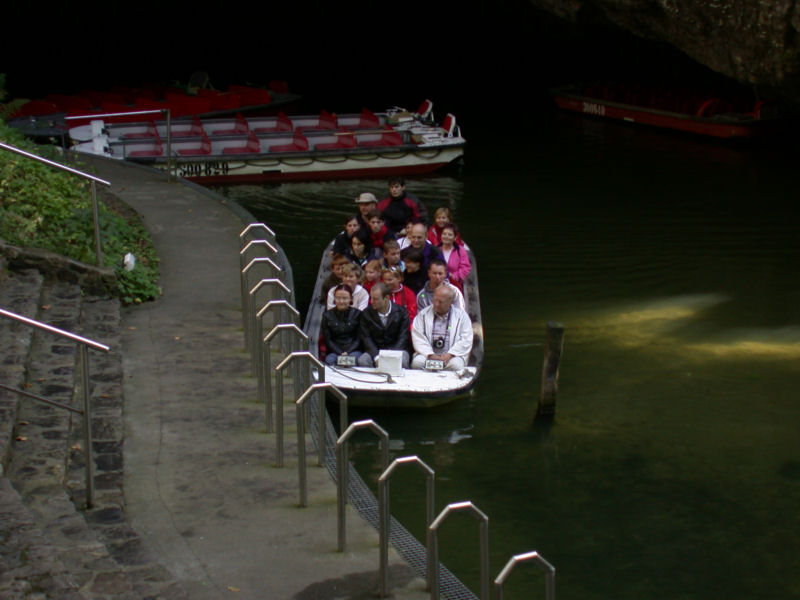
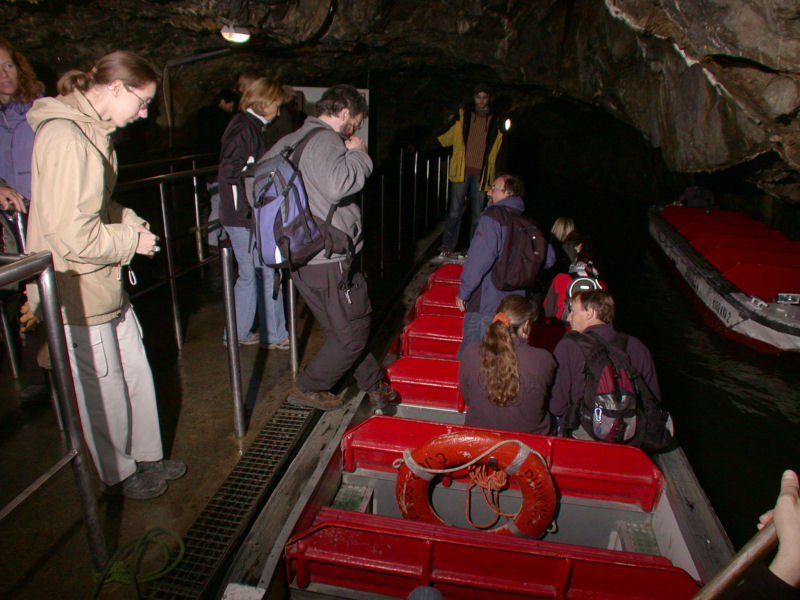
Upper Landing Stage. This is the most relaxing part of the journey. The visitor boards an electric powered boat for a half kilometre cruise through the Water Domes of Macocha. The first part of the cruise passes through cave galleries where the water is only a metre deep. The corridors lead into the Black Lake Dome. The chimneys in the roof of this series connect with a system of passages and galleries in the upper level. The water temperature is about 6 °C whereas the air temperature is about 10 °C. Both values tend to be constant throughout the year reflecting the annual mean temperature of the region. Visitors now approach a place call the Forty. The water at this point is 40 m in depth and rises from the mouth of a deep sump. This is the same River Punkva which sinks in the lake at the bottom of the Macocha Abyss. A short section of man made tunnels leads back into natural cavities where the water is about 20 m deep. The preserved relics of the original cave roof hide the southern branch of the so called Wicked Siphon which is 18 m deep. This was pumped dry and explored in 1933. Next is the First Fairy Tale Lake with a speleothem called The Water Elf. The passage then dips beneath the water table and a slight detour in made into the Third Fairy Tale Lake. The next chamber is called the Dragon's Gallery and it is through this that visitors enter the Forth Fairy Tales Lake. Here they leave the boat and visit the loveliest part of the Punkva Caves.
The Masaryk Dome. This chamber was accidentally discovered by a military detachment from Olomouc under the leadership of Second Lieutenant Sláma. The soldiers were drilling and blasting a passage at water level trying to reach a chamber which Dr J Wankel explored by raft in 1857. The sappers also discovered a fine set of Pleistocene beaver bones. Visitors are always surprised by the marvellous display of speleothems in the Masaryk Dome. Although some formations were damaged by the blasting, the management takes great care in the conservation of this area. They carefully monitor the microclimate and anything else which would have a detrimental impact.
Returning to the boats the trip passes the very end of the Fourth Fairy Tale Lake. A few minutes later and it is possible to see the glow of daylight penetrating the caves through the impressive gate of the Punkva River resurgence in the Pusty zleb Valley.
Text by Tony Oldham (2002). With kind permission.
Many years ago various caves where discovered in the area north of Punkevní jeskyně. One of the first was the Amaterska jeskyně, who was discovered and explored by geology students, but the results were published by their professors, who received all the fame. In order to remember the professors and the readers of their papers who discovered the cave, they used the right of the discoverer and named it Amateurs cave. So all following papers would contain a hint on the real discoverers in the name of the cave itself.
Later another part of the cave system, consequently called Nova Amaterska, was discovered and an artificial tunnel built to allow easier research.
When the connection to the Propast Macocha (Macocha Abysss) was found, the new System Amaterskej a Punkevni Jesky (Amaterska and Punkva Cave System) was 32,500 m long and the longest cave system of the Czech Republik.
But this was not the end.
In a very dry autumn in 2005 the local caving club pumbed a sump between Nova Amaterska and
 Sloupsko-Šošùvské jeskyně.
After one week they lowered the water level six meters, and the cave diver Jan Sirotka dived the series of sumps and reached the other side.
Now the whole cave system is about 38 km long!
Sloupsko-Šošùvské jeskyně.
After one week they lowered the water level six meters, and the cave diver Jan Sirotka dived the series of sumps and reached the other side.
Now the whole cave system is about 38 km long!
|
|
| Punkevní jeskyně Gallery |
 Propast Macocha
 Member of the International Show Caves Association (ISCA)
 Search Google for "Punkva River Cave"
 Google Earth Placemark
 Punkva Caves, official website (visited: 08-APR-2022)
 Index
Index Topics
 Hierarchical
 Countries
 Maps
Maps Search